How Parents Track Children's Vital Signs With a Contactless App
How parents use contactless smartphone apps to track children's vital signs at home, what the research says about rPPG in pediatric care, and where this is heading.
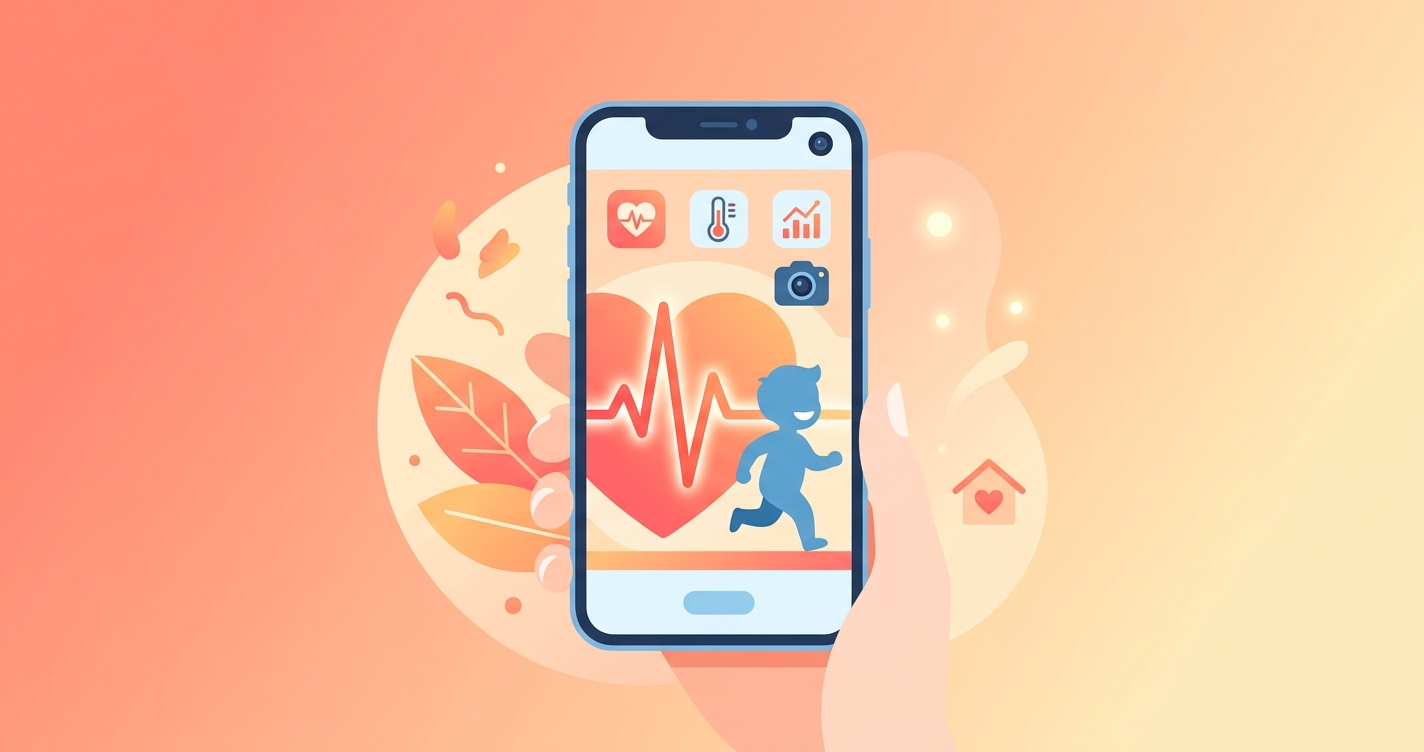
Parents track children's vital signs with a contactless app more often than most people realize. The scenario is pretty mundane at this point: a kid wakes up flushed at 2 AM, and instead of fumbling through a drawer for a thermometer with dead batteries, a parent holds up their phone. A 30-second camera scan picks up heart rate, respiratory rate, and blood oxygen estimates. No forehead strip, no armpit thermometer, no crying. According to a 2024 Grand View Research report, the mobile health app market hit $37.5 billion in valuation with projected growth to $86.37 billion by 2030. Pediatric use cases are a growing slice of that number, and the reason is straightforward: kids hate being poked and prodded, and parents hate doing it.
"Contactless vital sign monitoring in pediatric patients removes a significant source of distress for both children and caregivers. The less intrusive the measurement, the more reliable the data tends to be, because the child is calmer." — Ahmad Hatib et al., Annals of Translational Medicine, 2023
Why contactless monitoring works well for children
Children are terrible patients. Not in a moral sense, obviously, but in the practical sense that getting accurate vital sign readings from a squirming four-year-old is genuinely difficult. A pulse oximeter clip on a toddler's finger stays put for about three seconds. Blood pressure cuffs sized for small arms are uncomfortable and often inaccurate. The whole process tends to escalate, which then elevates the very readings you are trying to measure.
Remote photoplethysmography, or rPPG, sidesteps most of this. The technology uses a smartphone camera to detect micro-changes in skin color caused by blood flowing beneath the surface. Each heartbeat sends a tiny pulse of blood to capillaries near the skin, and the camera picks up the resulting color variation — invisible to the eye but readable by software. The child does not need to hold still for long. They do not need anything attached to their body. They just need to be roughly facing the camera for about 30 seconds.
A two-phased study by Hatib et al. published in the Annals of Translational Medicine (2023) tested rPPG on pediatric patients aged 12 to 16 and found that heart rate measurements correlated well with standard-of-care monitors. The study described the method as "acceptable and feasible" for contactless vital sign acquisition in pediatric settings. That language is intentionally cautious — this is still an evolving area of research — but the trajectory is clear.
Pediatric vital signs differ significantly from adult ranges, which matters for any monitoring tool. Cleveland Clinic's pediatric reference data shows that a normal resting heart rate for a one-year-old is 80 to 160 bpm, while a ten-year-old's range is 70 to 110 bpm. Respiratory rates are similarly variable by age. Any app designed for family use needs to account for these differences, and the better ones do.
Comparing methods for monitoring children's vital signs at home
| Method | Contact required | Child tolerance | Setup time | Accuracy for pediatric use | Cost per household |
|---|---|---|---|---|---|
| Traditional thermometer (oral/rectal) | Yes — direct body contact | Low — discomfort, crying | 1-3 minutes | High for temperature only | $5-15 |
| Pulse oximeter (finger clip) | Yes — clip on finger | Low for toddlers, moderate for older kids | 30 seconds | Moderate — poor fit on small fingers | $20-40 |
| Blood pressure cuff (pediatric) | Yes — arm cuff | Low — tight, uncomfortable | 2-5 minutes | Moderate — sizing issues common | $40-80 |
| Wearable fitness band | Yes — worn on wrist | Moderate — some kids resist wearing | Ongoing | Limited pediatric validation | $100-300 |
| Contactless rPPG app (smartphone) | No — camera only | High — nothing touches the child | 30 seconds | Growing evidence base, heart rate strongest | Free to $15/month |
The gap in that table that jumps out is the tolerance column. Everything that touches the child scores low or moderate. The contactless option scores high because there is nothing to tolerate. For a parent trying to check on a sick kid without waking them fully or starting a meltdown, that difference is practical, not theoretical.
How parents actually use contactless vitals apps
The midnight fever check
This is the most common scenario, and it barely needs explaining to anyone who has parented a child under six. Kid feels warm. You want to know if their heart rate is elevated, if their breathing is faster than usual, whether this is a "give them water and go back to sleep" situation or a "call the nurse line" situation. A contactless scan from across the pillow gives you data without turning on lights, without physical contact, without fully waking the child.
Tracking patterns over time
Some children have recurring health issues — asthma, post-viral reactive airway symptoms, anxiety-related tachycardia. Parents tracking these conditions often find that individual readings matter less than trends. A respiratory rate that has been creeping up over three days tells a pediatrician more than a single measurement in the office. Contactless apps that log readings over time give families a record to bring to appointments.
Pre-sports and activity clearance
Youth sports programs increasingly ask for health screening. While a contactless app is not a substitute for a physical exam, parents use resting heart rate and heart rate variability data to keep a baseline on their active kids. A resting heart rate that suddenly spikes 15-20% above baseline can signal overtraining, illness onset, or dehydration before other symptoms appear.
Managing health anxiety (the parent's, not the child's)
Here is something that does not get discussed enough: parental health anxiety is real, and it drives a lot of unnecessary ER visits. A 2022 study in Pediatric Emergency Care found that parental anxiety was the primary driver in roughly 30% of non-urgent pediatric emergency department visits. Having a way to quickly check basic vitals at home does not replace medical judgment, but it gives anxious parents a data point to anchor their decision-making. "Heart rate and breathing look normal" is sometimes all a parent needs to hear at 3 AM.
Current research and evidence
The research on rPPG in pediatric populations is still building. Most large-scale validation studies have focused on adults, and applying those findings to children requires caution because of the physiological differences in pediatric vital signs.
That said, the existing pediatric-specific work is promising. The Hatib et al. study (2023) in the Annals of Translational Medicine remains one of the more direct examinations of rPPG feasibility in pediatric patients. Their finding that heart rate measurements in children aged 12 to 16 correlated well with clinical monitors is notable because that age group is old enough to sit reasonably still but young enough to represent a genuinely pediatric population.
A 2022 review published in PMC on remote monitoring of patient- and family-generated health data in pediatrics (Stelter et al., Pediatrics) noted that as technology advances, pediatric remote monitoring will move from simple data collection toward integrated clinical decision support. The authors described a future where health deterioration detection happens automatically, with alerts going to both families and care teams.
For younger children, the challenge is motion artifact. A three-year-old does not sit still, and rPPG algorithms need a relatively stable face in frame. Current-generation software handles moderate movement better than earlier versions, but this remains an active area of development. Research groups at institutions including MIT and the University of Toronto have published work on motion-robust rPPG algorithms that perform better in real-world conditions where subjects move naturally.
Where pediatric contactless monitoring is heading
The near-term trajectory looks like two parallel tracks. On one track, consumer apps get better at handling the specific challenges of pediatric measurement — smaller faces, more movement, different vital sign ranges. On the other, clinical validation studies expand to include younger age groups and larger sample sizes.
The American Academy of Pediatrics has not yet issued formal guidance on contactless vital sign apps, but the broader shift toward remote patient monitoring in pediatric care is well documented. CMS expanded RPM reimbursement codes in recent years, and pediatric practices are starting to incorporate remote data into chronic care management workflows.
What makes the pediatric use case particularly compelling is that children grow up with this technology. A ten-year-old who learns to do a quick health scan on their phone will not think twice about doing it as a twenty-year-old. The habit formation starts early, and that has implications for preventive health that extend well beyond childhood.
Integration with pediatric electronic health records is another area moving forward. When a parent can share a week of vital sign trends directly with their child's pediatrician — rather than saying "she seemed warm on Tuesday, I think" — the quality of remote consultations goes up.
Frequently asked questions
Is a contactless app accurate enough to replace a pediatrician visit?
No. Contactless apps provide estimates that are useful for monitoring trends and making triage decisions at home, but they are not diagnostic tools. If your child is seriously ill, see a doctor. The apps work best as a layer of information between visits, not a replacement for clinical care.
At what age can rPPG technology work on children?
Most current apps work best on children who can sit or lie relatively still for 30 seconds — roughly age three and up. For infants and toddlers, motion artifact is still a significant challenge, though this is an area of active research. Sleeping infants can sometimes be scanned successfully because they are naturally still.
Do these apps store my child's health data securely?
This varies by app. Look for apps that comply with HIPAA or equivalent data protection standards, use encryption for stored data, and have clear privacy policies about how children's health information is handled. Under COPPA (Children's Online Privacy Protection Act), apps collecting data from children under 13 face additional regulatory requirements in the United States.
What vital signs can a contactless app measure on my child?
Most rPPG-based apps can estimate heart rate, respiratory rate, heart rate variability, and blood oxygen saturation. Heart rate tends to be the most accurate measurement. Blood pressure estimation from camera-based methods is still in earlier stages of development and should be treated as a rough trend indicator rather than a precise reading.
Families looking for contactless health monitoring options can explore what companies like Circadify are building in this space. The ability to check a child's vital signs with just a phone camera, no wearables or extra devices, is the kind of practical health tool that parents have wanted for a long time. If you have not tried a contactless health scan yet, it takes about 30 seconds.