Is a phone-based health scan as accurate as a smartwatch?
Is a phone-based health scan as accurate as a smartwatch? This analysis compares camera-based scans and wearables across heart rate, trends, convenience, and real-world use.
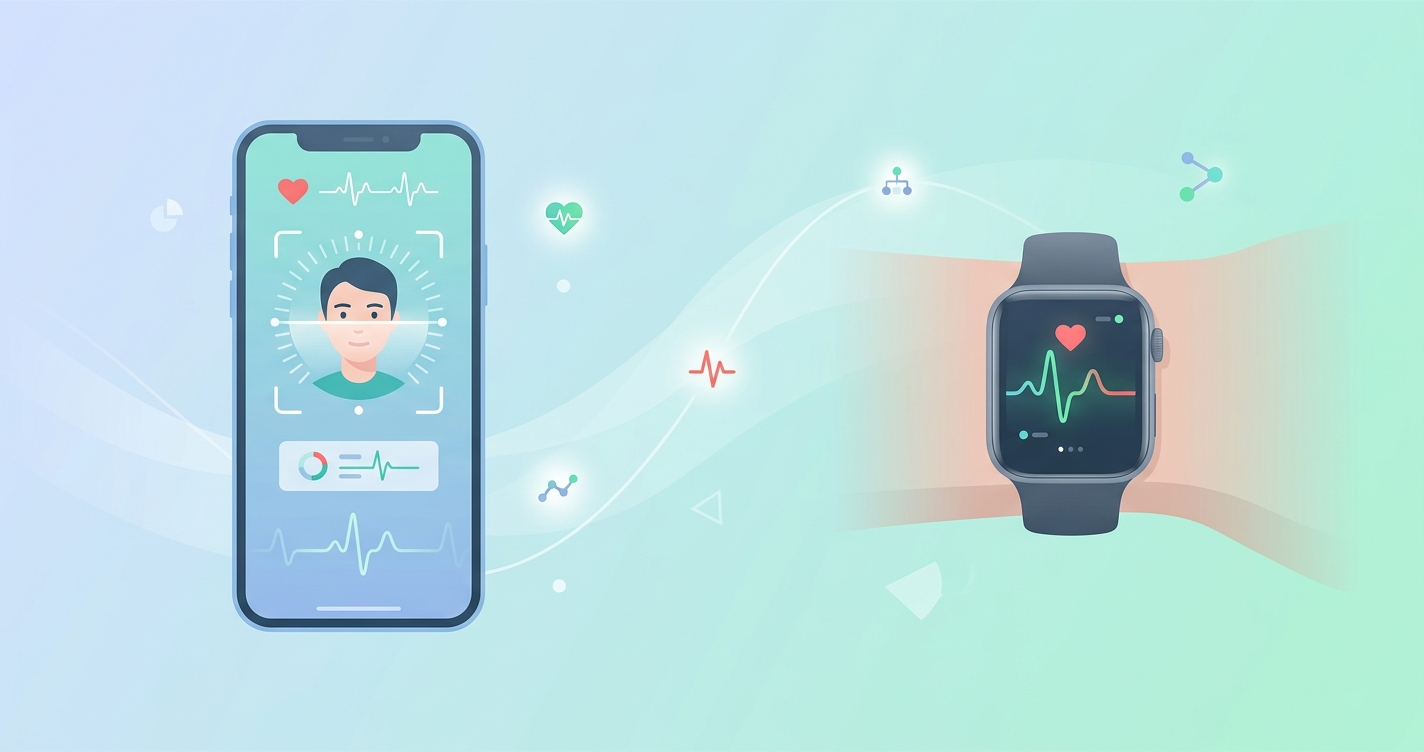
If you're searching for a phone health scan vs smartwatch answer, the short version is this: for a quiet, on-demand reading at rest, a phone-based scan is closer to smartwatch accuracy than most people expect. For continuous tracking, workouts, and passive data collection, the smartwatch still wins. The interesting part is where those lines cross. A lot of people do not need round-the-clock monitoring. They need a fast reading they will actually take.
"Non-contact, automated cardiac pulse measurements using video imaging" showed that a standard camera could recover pulse signals from the face. — Ming-Zher Poh, Daniel McDuff, and Rosalind Picard, MIT, Optics Express (2010)
Phone health scan vs smartwatch: what accuracy really means
People tend to ask this question as if there is one universal scorecard. There isn't. Accuracy depends on what you are measuring, when you are measuring it, and how much motion is involved.
A smartwatch uses contact photoplethysmography, or PPG. LEDs on the wrist shine light into the skin, and the watch reads the reflected signal. A phone-based scan uses remote photoplethysmography, or rPPG. The camera looks for tiny color changes in the face caused by blood flow. The signal source is similar. The collection method is not.
That difference matters.
At rest, both systems can produce strong heart rate readings. During exercise, a wrist wearable usually holds up better because it was built for repeated motion and continuous sampling. A phone scan is better understood as a snapshot tool. It answers, "What do my vitals look like right now?" A smartwatch is better at, "What happened over the last 12 hours?"
Verkruysse, Svaasand, and Nelson at UC Irvine helped establish the scientific basis for rPPG in Optics Express (2008), showing that ambient-light video could recover pulse and breathing signals from the face. That early work matters because it moved camera-based measurement out of the gimmick category and into real physiological sensing.
Where a phone-based health scan is close to smartwatch performance
The strongest overlap is resting heart rate.
A 2024 clinical validation paper on rPPG-enabled contactless pulse monitoring in cardiovascular disease patients came from teams at PanopticAI, The Hong Kong University of Science and Technology, and Prince of Wales Hospital at the Chinese University of Hong Kong. The study reported a mean absolute error as low as 2.96 beats per minute and classification accuracy of 99.1% for pulse rate under the tested conditions.
That does not mean every phone app matches every premium wearable in every setting. It does mean the old assumption — camera-based scans are automatically much worse — is outdated.
Recent smartwatch reviews and meta-analyses point in the same direction from the wearable side: the best devices are very good at resting heart rate, but "smartwatch accuracy" is not a single number either. Apple and Garmin tend to perform well in published comparisons, while lower-cost devices can vary more. So the fair comparison is not "phone vs smartwatch" in the abstract. It is "good phone implementation vs good wearable implementation, under the same conditions."
| Use case | Phone-based health scan | Smartwatch |
|---|---|---|
| Resting heart rate | Often very strong in stable lighting and low motion | Very strong, especially on premium devices |
| Continuous monitoring | No, typically on-demand scans | Yes, all-day and overnight |
| Exercise tracking | Limited, motion hurts signal quality | Better fit for workouts and recovery tracking |
| Hardware required | Smartphone camera only | Separate device purchase and charging |
| Respiratory insights | Often available from the same face scan | Sometimes available, depends on device and software |
| HRV snapshots | Possible during a guided scan | Better for repeated passive trend collection |
| Ease of mass access | High, since most people already have a phone | Lower, because not everyone owns a smartwatch |
| Best use case | Quick check-ins, screening, trend snapshots | Passive tracking, fitness, longitudinal monitoring |
Where the smartwatch is still more accurate in practice
This is the part that gets lost in marketing copy.
The smartwatch usually wins in real-world messiness. If you are walking, working out, glancing at your wrist during a run, or trying to build an overnight trendline, the wearable has structural advantages. It is already on the body. It samples continuously. It is designed around dedicated sensors rather than a general-purpose front camera.
That is why the question should not be reduced to lab-grade heart rate alone. In actual life, convenience changes accuracy because convenience changes compliance. A reading you never take is useless, even if the device is excellent.
Smartwatches also have a deeper bench for fitness use. They are better at capturing changes through exercise sessions, recovery windows, and sleep periods. If you want passive data without thinking about it, wrist wearables are still the obvious fit.
Where the phone scan can be more useful than the smartwatch
A phone scan has one huge advantage: access.
Most adults already own a smartphone. Far fewer own a premium smartwatch, and even fewer wear it consistently enough for the data to matter. A guided 30-second scan can be more useful than a theoretically superior device that sits in a drawer three days a week.
That is not just a consumer argument. It matters for telehealth, screening, insurance intake, and employer wellness programs. Software scales in a way hardware doesn't.
A 2024 JMIR Aging pilot study led by Huitong Ding and colleagues found that older adults showed decent daily adherence to wearables overall, but maintaining consistent use across consecutive days was harder. That sounds minor until you remember what trend-based health tools need: repeated measurements. If people skip enough days, the dataset gets ragged fast.
For health-curious consumers, the tradeoff is pretty simple:
- A smartwatch is better if you want passive tracking all day
- A phone scan is better if you want a quick answer without buying another device
- A phone scan also lowers the barrier for people who are curious but not yet committed to wearables
- For broad population reach, phones are hard to beat
Industry applications for phone scans and wearables
Consumer self-checks
This is probably the cleanest use case for phone scans. Someone wants to check heart rate, breathing pattern, or a stress-related signal right now, without putting on a device or waiting for a clinic visit. The phone is already there.
Telehealth and virtual care
A watch can share useful background data, but a phone scan fits the flow of a virtual appointment more naturally. Open the app, look at the screen, capture a reading, move on. No pairing issues, no assumption that the patient owns a wearable.
Fitness and performance tracking
This is still smartwatch territory. Continuous collection during movement matters more than a one-time snapshot. Athletes who care about intervals, overnight recovery, and training load usually want the wearable stream.
Population-scale screening
This is where phone-based scanning gets interesting. If a company, insurer, or care program wants the widest possible participation, relying on existing smartphone hardware is a lot easier than distributing wearables.
Current research and evidence
The research story here did not begin in 2026. The field has been building for years.
Poh, McDuff, and Picard at MIT showed in 2010 that facial video could recover cardiac pulse signals without contact. Before that, Verkruysse, Svaasand, and Nelson at UC Irvine demonstrated ambient-light remote plethysmographic imaging in 2008.
More recent review work by Uday Debnath and Sungho Kim at Yeungnam University, published in 2025, described how deep learning has improved rPPG heart rate estimation, particularly around signal extraction and noise handling. That does not magically erase lighting and motion problems, but it helps explain why phone-based measurements have become more credible over the last few years.
On the validation side, the PanopticAI-HKUST-CUHK clinical study is one of the stronger reference points because it looked at real patients rather than idealized student cohorts. Their results suggest that contactless pulse measurement can perform within a clinically relevant range for pulse rate under controlled use.
The smartwatch literature reaches a similar conclusion from the other direction: good wearables are strong for heart rate, especially at rest, but performance shifts across brands, firmware, skin contact, and activity level. If you've read our deeper breakdown of rPPG vs smartwatch heart rate accuracy, you'll notice the same pattern. The gap is narrower at rest than many people think.
If you're newer to the space, our explainer on what vital signs a phone camera can measure is a good companion read, because accuracy also depends on whether you are talking about heart rate, respiratory rate, HRV, or broader estimates.
The future of phone-based health scans
I don't think phones replace smartwatches outright. That's probably the wrong frame.
The more likely outcome is that each tool settles into the job it is naturally good at. Smartwatches remain the passive, always-on layer. Phone scans become the low-friction layer for quick screening, onboarding, telehealth, and consumer trial.
That is especially relevant for companies trying to reach people before they ever buy hardware. A phone-based scan lets someone test the experience first. That lowers friction, and friction is usually what kills health-tech adoption long before the science does.
Solutions like Circadify are being built around that idea: use the camera people already have, make the scan fast, and turn casual curiosity into a usable health signal. For many consumers, that is a more realistic starting point than asking them to buy and wear another device.
Frequently asked questions
Is a phone-based health scan as accurate as a smartwatch for heart rate?
At rest, it can be surprisingly close. Research on rPPG shows strong pulse-rate performance under stable conditions. In motion-heavy settings like workouts, smartwatches usually perform better.
Why do phone scans and smartwatches disagree sometimes?
They measure through different setups. A smartwatch reads from the wrist with dedicated sensors. A phone scan reads facial blood-flow signals through a camera. Lighting, movement, skin contact, sampling window, and algorithm design can all shift the result.
Which is better for daily health check-ins?
If you want a fast, intentional reading once or twice a day, the phone is often enough. If you want passive trends while you sleep, exercise, and go about your day, a smartwatch is better.
Should I buy a smartwatch if my phone can already scan vitals?
That depends on how much data you want. If you are mostly curious and want low-friction check-ins, start with the phone. If you want continuous tracking and fitness metrics, a smartwatch gives you more coverage.