
rPPG vs Smartwatch Heart Rate: Accuracy Comparison in 2026
How does rPPG camera-based heart rate measurement compare to smartwatch accuracy in 2026? We break down the clinical data, error margins, and real-world tradeoffs.
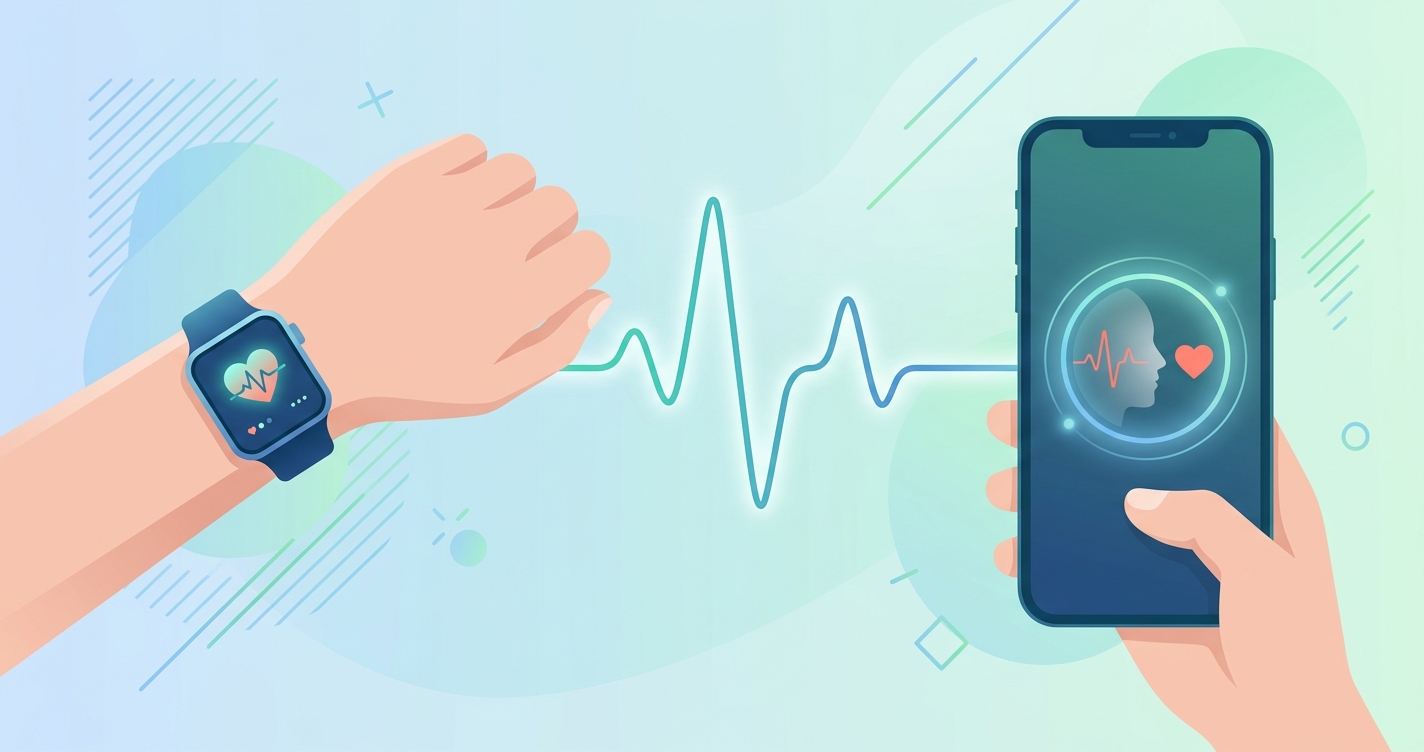
The rPPG vs smartwatch heart rate accuracy debate has gotten more interesting in the last year. Both technologies read your pulse using photoplethysmography, the detection of blood volume changes through light. One does it from your wrist with LEDs pressed against skin. The other does it from a phone camera pointed at your face. Same underlying physics, very different engineering problems, and the accuracy gap between them is smaller than most people assume.
"Remote photoplethysmography in controlled conditions is approaching PPG-level accuracy, with a 2025 clinical validation study of 562 participants reporting mean absolute error of 2.96 bpm and heart rate accuracy of 99.1%." — Shoushan et al., 2025 clinical validation study
How smartwatch and rPPG heart rate measurement actually work
Smartwatches use contact PPG. Green LEDs on the back of the watch shine into your wrist, and photodiodes measure how much light bounces back. Blood absorbs green light, so each heartbeat creates a tiny dip in reflected light intensity. The watch's algorithm extracts heart rate from that pulsatile signal.
rPPG works on the same absorption principle but without touching skin. A camera records your face, and software detects the subtle color fluctuations that happen with each cardiac cycle. These changes are invisible to the naked eye but readable by a CMOS sensor. Poh, McDuff, and Picard at MIT demonstrated this approach in Optics Express (2010), extracting pulse waveforms from the green channel of standard webcam video where hemoglobin absorption is strongest.
The fundamental difference: smartwatches have dedicated optical hardware optimized for one job. rPPG repurposes a general-purpose camera. That distinction matters less than it used to.
The accuracy numbers in 2026
A January 2026 meta-analysis published in npj Digital Medicine pooled data from 82 studies with over 430,000 participants. The findings for smartwatches: Apple Watch showed a mean heart rate bias of just -0.27 bpm compared to reference devices. Garmin performed similarly well. Fitbit trailed slightly behind both.
Sicbaldi et al. (2026) reviewed up to 39 published studies comparing consumer smartwatches and found that Garmin and Apple were statistically tied for top accuracy, with Fitbit consistently a step behind.
On the rPPG side, the Shoushan et al. (2025) clinical validation with 562 participants reported 99.1% heart rate accuracy and a mean absolute error of 2.96 bpm against reference-grade devices. That puts rPPG in controlled conditions within the same accuracy neighborhood as the best smartwatches.
A separate study published in JMIR Formative Research (2026) tested 10 commercial wearables and found significant variability across devices, consistent with earlier work by Düking et al. showing marked differences in accuracy among Apple Watch, Polar, Garmin, and Samsung devices. The point being: "smartwatch accuracy" is not one number. It depends heavily on which watch, which firmware version, and what the person is doing.
rPPG vs smartwatch heart rate: head-to-head comparison
| Feature | Smartwatch PPG | rPPG (camera-based) |
|---|---|---|
| Contact required | Yes, wrist contact | None |
| Hardware cost | $200–$500 for medical-grade models | Smartphone camera (already owned) |
| Measurement mode | Continuous or on-demand | On-demand, 15–60 second scan |
| Heart rate accuracy (resting) | ±1–3 bpm (Apple Watch, Garmin) | ±2–3 bpm in controlled conditions |
| Heart rate accuracy (exercise) | ±5–10 bpm depending on intensity | Not designed for active exercise |
| Additional vitals | SpO2, ECG (some models), skin temp | HR, HRV, respiratory rate, SpO2 estimate, stress |
| Motion sensitivity | Wrist movement degrades signal | Head/face movement degrades signal |
| Skin tone considerations | Some wrist-based bias documented | Uses facial reflectance, different optical path |
| Battery requirement | Needs charging every 1–7 days | Uses phone battery |
| Compliance barrier | Must wear device consistently | Open app, scan face, done |
| Data integration | Proprietary health apps | API-based, platform-agnostic |
Where smartwatches still win
Continuous monitoring is the obvious advantage. A smartwatch tracks your heart rate all day and night, catching resting heart rate trends, sleep patterns, and exercise intensity. rPPG gives you snapshots. If you need 24/7 passive tracking, a wrist-worn device is the only option right now.
Exercise accuracy also favors smartwatches. During running or cycling, the chest-strap-like accuracy of newer watches (especially those using multiple wavelengths) handles motion artifacts better than any camera pointed at a bouncing face would. Düking et al. found that even among wearables, accuracy degrades during high-intensity activity, but the best devices maintain usable readings.
ECG capability is another smartwatch exclusive. The Apple Watch and Samsung Galaxy Watch can record single-lead electrocardiograms, which is an entirely different measurement from PPG. rPPG extracts heart rhythm information from blood volume changes, but it cannot produce an ECG waveform.
Where rPPG has the edge
Cost and accessibility are the big ones. According to Statista, global smartwatch ownership sits around 15% of adults. The other 85% still have phone cameras. rPPG turns an existing device into a vital signs scanner without purchasing, charging, or wearing anything extra.
Compliance is the second major advantage. In clinical and insurance settings, getting people to consistently wear a device is a well-documented problem. A 2024 study in the Journal of Medical Internet Research found wearable adherence drops below 50% after six months. rPPG sidesteps this entirely: open an app, scan for 30 seconds, close the app.
Scalability follows from cost. Deploying rPPG to 10,000 insurance applicants or corporate wellness participants requires a software update. Deploying smartwatches requires 10,000 devices, shipping logistics, and a support infrastructure for returns and replacements.
rPPG also captures more vitals in a single scan. Beyond heart rate, camera-based systems extract respiratory rate, heart rate variability, and stress indicators from the same video feed. A smartwatch can do some of this, but often requires different sensors or separate measurement modes.
Clinical and industry applications
Insurance and underwriting
Life insurance carriers are particularly interested in rPPG because it removes the paramedical exam bottleneck. An applicant can complete a biometric screening from their phone in under a minute, compared to scheduling a nurse visit or mailing a testing kit. The accuracy margins for underwriting don't require ECG-level precision; they need reliable resting heart rate and basic cardio indicators.
Telehealth
Virtual care visits have an obvious limitation: the provider can't take vital signs through a video call. rPPG changes that equation. During a telehealth session, a patient's camera can simultaneously capture heart rate and respiratory rate without any additional hardware. Smartwatches could theoretically share data during a call, but that requires the patient to own one and have it synced.
Corporate wellness
Annual biometric screenings are expensive when they require onsite nurses and equipment. rPPG-based screening lets employees scan from any location using their phone, which reduces per-screening costs from $30–$50 down to essentially zero marginal cost per scan.
Remote patient monitoring
Chronic care management programs need regular vital sign check-ins. Wearable compliance is a persistent problem in these populations, especially among elderly patients. A phone-based scan is simpler and doesn't require maintaining a charged, properly positioned device on the wrist.
Current research and evidence
The evidence base for both technologies has grown substantially. The 2026 npj Digital Medicine meta-analysis (82 studies, 430,000+ participants) is the largest validation of smartwatch heart rate accuracy to date. It confirmed that Apple Watch and Garmin lead the pack, with mean biases under 1 bpm at rest.
For rPPG, Verkruysse, Svaasand, and Nelson established in their 2008 Optics Express paper that contactless pulse measurement from ambient light was feasible. Since then, the field has progressed from proof-of-concept to clinical-grade performance. The Shoushan et al. 2025 study with 562 participants is among the largest rPPG validation studies, and its 2.96 bpm mean absolute error puts camera-based measurement in direct competition with wrist-worn devices.
JMIR Formative Research published a 2025 study on wearable heart rate tracker validation during ambulatory conditions, and a 2026 study testing 10 commercial devices. Both found that accuracy varies more between devices than most consumers realize. The cheapest Fitbit and the latest Apple Watch are not interchangeable in terms of measurement quality.
A 2025 meta-analysis of 26 studies on smartwatch atrial fibrillation detection found that Amazfit demonstrated 100% sensitivity and 97% specificity, the highest among all devices tested. This points to an interesting future where both wearables and camera-based systems converge on rhythm detection, not just rate measurement.
The future of rPPG vs smartwatch accuracy
The gap is closing, and in some use cases it's already closed. At rest, with good lighting and a steady face, rPPG matches the best smartwatches. The question is how fast rPPG improves in non-ideal conditions: variable lighting, motion, diverse skin tones, and different camera hardware.
Smartwatches will likely add more sensors (blood pressure, glucose estimation, body temperature trends), making them multi-parameter health hubs. rPPG will likely push into more vital parameters too, but through algorithmic improvement rather than hardware additions.
The two technologies aren't really competing for the same use cases. Smartwatches serve people who want continuous, passive health tracking and are willing to buy and wear a device. rPPG serves situations where you need a quick vital signs check from the largest possible population with the lowest possible friction. Insurance screening, telehealth visits, corporate wellness programs, and remote patient monitoring all fit the rPPG model better.
Companies like Circadify are building out the rPPG side of this equation, making camera-based vitals accessible through SDK and API integrations. If you're evaluating how contactless vitals could work for your use case, Circadify's platform is worth looking at.
Frequently asked questions
Is rPPG as accurate as a smartwatch for heart rate?
In controlled conditions at rest, yes. A 2025 clinical study of 562 participants found rPPG achieved 99.1% heart rate accuracy with a mean absolute error of 2.96 bpm. The best smartwatches (Apple Watch, Garmin) show mean biases under 1 bpm at rest. During exercise, smartwatches maintain better accuracy because they handle motion artifacts differently.
Can rPPG replace a smartwatch?
For continuous monitoring, no. rPPG provides on-demand snapshots, not 24/7 tracking. But for periodic vital sign checks, health screenings, and telehealth applications, rPPG offers comparable accuracy without requiring any device purchase or wearable compliance.
Which is better for detecting heart conditions?
Both can detect irregular heart rhythms through different mechanisms. Smartwatches with ECG capability (Apple Watch, Samsung Galaxy Watch) can record single-lead electrocardiograms, which rPPG cannot. For basic heart rate and rhythm screening, both technologies perform well. A 2025 meta-analysis found certain smartwatches achieved over 97% specificity for atrial fibrillation detection.
Does skin tone affect accuracy for either technology?
Both technologies face challenges with darker skin tones, though through different mechanisms. Pulse oximeters and smartwatches have documented accuracy variations related to skin pigmentation at the wrist. rPPG uses facial reflectance through a different optical path, and research is ongoing to characterize its performance across skin tones. Neither technology is fully immune to this issue.