
rPPG vs Pulse Oximeter: What Is the Difference?
Understand the difference between rPPG and pulse oximeters. Compare how contactless camera-based vitals and finger-clip sensors measure heart rate, SpO2, and more.
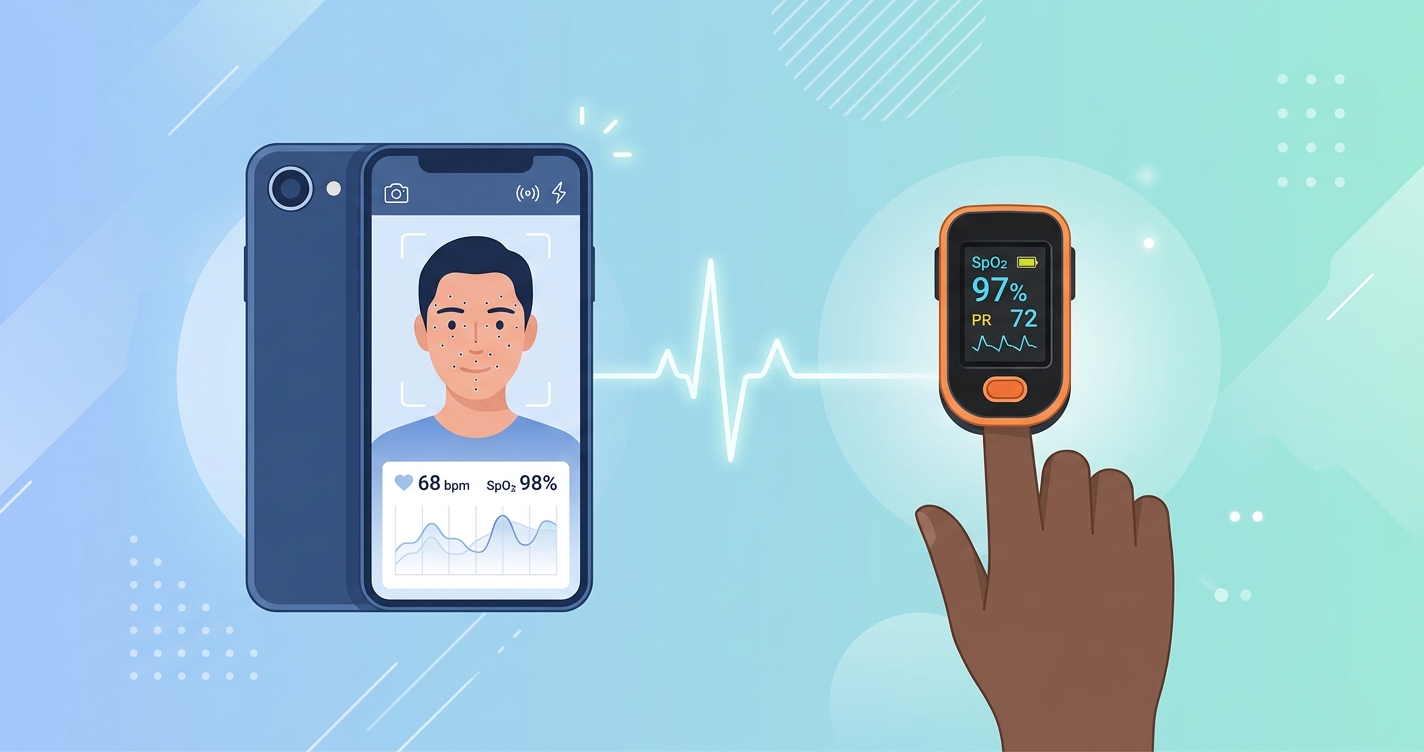
Both rPPG and pulse oximeters measure your heartbeat by tracking how blood absorbs light. But they go about it in completely different ways, and the rPPG vs pulse oximeter difference matters more than most people realize. One requires physical contact and a dedicated device. The other works through a standard camera from a distance. The gap between these two approaches has real consequences for accessibility, cost, and who actually gets screened.
"Remote photoplethysmography extracts cardiovascular signals from video sequences of the human face, enabling contactless physiological measurement using consumer-grade cameras." -- Verkruysse, Svaasand & Nelson, Optics Express, 2008
How each technology actually works
Pulse oximeters have been around since the 1980s. The device clips onto your fingertip and shines two wavelengths of light (red and infrared) through your skin. Oxygenated and deoxygenated hemoglobin absorb these wavelengths differently, and a photodetector on the other side of your finger reads the difference. That ratio gives you a blood oxygen saturation (SpO2) reading, and the pulsatile signal gives you heart rate.
rPPG (remote photoplethysmography) works on a related principle but without any skin contact. A camera records your face, and algorithms detect the tiny color fluctuations that happen each time your heart pushes blood through facial capillaries. These fluctuations are invisible to the eye but are well within range of a modern CMOS sensor. Signal processing isolates the pulse waveform from the green channel, where hemoglobin absorption is strongest, according to research by Poh, McDuff, and Picard at MIT published in Optics Express (2010).
The extracted waveform can yield heart rate, respiratory rate, heart rate variability, and estimated blood oxygen saturation.
rPPG vs pulse oximeter: head-to-head comparison
| Feature | Pulse oximeter | rPPG (camera-based) |
|---|---|---|
| Contact required | Yes, finger clip | None |
| Hardware | Dedicated sensor ($15-$300) | Any smartphone camera |
| Measurement time | Continuous while clipped | 15-60 seconds per scan |
| Primary outputs | SpO2, heart rate | HR, HRV, respiratory rate, SpO2 estimate |
| Portability | Small but separate device | Built into the phone you carry |
| Skin tone sensitivity | Documented bias in darker skin tones | Uses facial reflectance, different optical path |
| Hygiene | Shared clips need cleaning | Zero physical contact |
| Cost per reading | Device purchase + battery | Software only |
| Movement tolerance | Sensitive to finger motion | Sensitive to head/face motion |
| Use in cold environments | Poor perfusion reduces accuracy | Not affected by peripheral circulation |
Where pulse oximeters fall short
Pulse oximeters are reliable in controlled clinical settings, but they have known blind spots. One that has gotten significant attention: accuracy varies by skin pigmentation.
A 2025 study presented at the American College of Cardiology's Annual Scientific Session (ACC.25), led by Dr. Carolyn Hendrickson at UC San Francisco, found that pulse oximeters performed differently across skin pigment categories. In the largest prospective real-world study of its kind with critically ill patients, the proportion of dangerously positive bias (where the device overestimates oxygen saturation, potentially masking low levels) was higher in patients with dark skin pigment. This matters for triage, treatment decisions, and whether a patient gets supplemental oxygen.
Beyond the skin tone issue, pulse oximeters also struggle when peripheral circulation is poor. Cold fingers, low blood pressure, Raynaud's disease, or certain cardiac conditions can all degrade readings. The device depends on adequate blood flow through the fingertip, which is not always available.
And then there is compliance. Asking someone to clip a device onto their finger sounds simple enough, but in population-level screening, the logistics compound quickly. Each device needs to be cleaned between uses, batteries need replacing, and the devices themselves can walk off.
Where rPPG has an edge
rPPG sidesteps many of these problems by not touching the person at all. No clip means no cleaning, no batteries, no lost devices. The measurement happens through a camera that most people already own.
A 2025 review published in Frontiers in Digital Health by researchers studying IntelliProve's rPPG technology compiled 96 studies and found heart rate accuracy of 99.1% for values under 101 bpm when compared to pulse oximeters, and respiratory rate accuracy within 6.9 bpm of a chest belt sensor. The review also identified rPPG's ability to derive heart rate variability, stress indicators, and blood pressure estimates from the same facial video.
The contactless nature also opens up use cases that pulse oximeters simply cannot serve. Neonatal monitoring is one example: babies in NICUs often have fragile skin where adhesive sensors cause damage. Burn patients are another, where any skin contact is painful. Elderly patients with thin, bruised skin from anticoagulants benefit from no-touch measurement too.
Screening at scale
The biggest practical difference may be scalability. Running a biometric screening event at a workplace or community health fair with pulse oximeters means buying dozens of devices, staffing people to administer them, and managing cleaning between uses. With rPPG, the same screening happens on each person's own phone. No equipment to ship, no cleaning protocol, no device inventory.
Telehealth integration
During a video call, rPPG can capture vitals without the patient needing any equipment at home. The camera that runs the video call is the same one reading vital signs. Pulse oximeters require the patient to own one and remember to use it during the appointment.
Where pulse oximeters still win
Pulse oximeters have decades of clinical validation behind them. The FDA has cleared hundreds of models, hospitals have built protocols around them, and clinicians trust them. For continuous SpO2 monitoring during surgery or in the ICU, a pulse oximeter (or its more advanced cousin, the arterial line) is the standard.
rPPG currently works best for spot-check measurements rather than continuous monitoring. It requires adequate lighting and a relatively still face. In a dark room or during vigorous exercise, readings degrade. Pulse oximeters, by contrast, work in total darkness and are less affected by ambient light conditions.
For patients on supplemental oxygen where precise SpO2 monitoring guides titration, a clinical-grade pulse oximeter remains the appropriate tool.
Current research and evidence
A 2024 study published on PubMed (Accuracy of heart rate, pulse oxygen saturation, and blood pressure using rPPG) enrolled adult volunteers from September to November 2024 and compared rPPG readings captured via mobile phone front cameras against simultaneous readings from standard clinical devices over approximately 90-second sessions. The researchers found reasonable agreement for heart rate and SpO2, though blood pressure estimation via rPPG remains an area of active development.
The Frontiers in Digital Health review (2025) went further, cataloging how rPPG research has expanded beyond basic vitals into mental stress detection, sleep quality estimation, and hypertension risk scoring. The review noted that while these higher-level health metrics are still exploratory, the foundational vitals (HR, RR, HRV) are well-established.
Dr. Wim Verkruysse's original 2008 work demonstrated that even ambient light and a basic webcam could extract a pulse signal from facial video. Since then, deep learning approaches have improved robustness against motion artifacts, lighting variation, and differences in skin tone.
The future of contactless vs. contact-based monitoring
These two technologies are not necessarily competing. They occupy different points on a spectrum of clinical rigor vs. accessibility.
Pulse oximeters will remain in hospitals and clinical settings where continuous monitoring and regulatory clearance matter. rPPG is likely to dominate in screening, telehealth, consumer health, and any scenario where the priority is getting some vital sign data from people who would otherwise have none.
The interesting convergence point is smartphones. Some manufacturers have explored built-in SpO2 sensors (Samsung tried it, then pulled it). Meanwhile, rPPG achieves similar measurements without any special hardware. As the algorithms improve and more validation studies accumulate, the line between "consumer wellness" and "clinical-grade" will keep shifting.
For now, the practical question is straightforward: if you need precise, continuous SpO2 monitoring in a clinical context, use a pulse oximeter. If you want to check your heart rate, track stress, or screen a population without distributing hardware, rPPG is the more practical path.
Frequently asked questions
Is rPPG as accurate as a pulse oximeter?
For heart rate, rPPG accuracy is comparable. A 2025 review in Frontiers in Digital Health reported 99.1% accuracy for heart rates under 101 bpm versus pulse oximeter readings. SpO2 estimation via rPPG is less mature but improving with each generation of algorithms.
Can rPPG replace my pulse oximeter at home?
For general wellness tracking and daily heart rate checks, rPPG works well through a smartphone camera. If your doctor has prescribed pulse oximetry for a specific condition like COPD or sleep apnea, continue using your clinical device until your care team says otherwise.
Does skin tone affect rPPG differently than pulse oximeters?
Pulse oximeters have documented accuracy variations across skin pigmentation levels, as shown in the 2025 ACC.25 study. rPPG uses reflected light from the face rather than transmitted light through the finger, which creates a different optical path. Research is ongoing to characterize rPPG's performance across diverse populations.
Do I need special lighting for rPPG?
Adequate ambient light is needed, similar to what you would want for a clear video call. Direct sunlight and very dim rooms can reduce accuracy. Most indoor environments with normal room lighting work fine.
Contactless vital sign measurement is one of the areas where companies like Circadify are building accessible tools. By turning the camera people already carry into a health sensor, rPPG-based solutions make basic screening possible for anyone with a smartphone, without asking them to buy or wear anything extra. Check out our article on what rPPG is and how your phone reads vital signs for a deeper technical breakdown.