How Nurses Use Phone-Based Vitals for Quick Patient Triage
Nurses are adopting phone-based vital signs tools for faster triage. Here's how camera-based vitals capture fits into emergency and clinical nursing workflows.
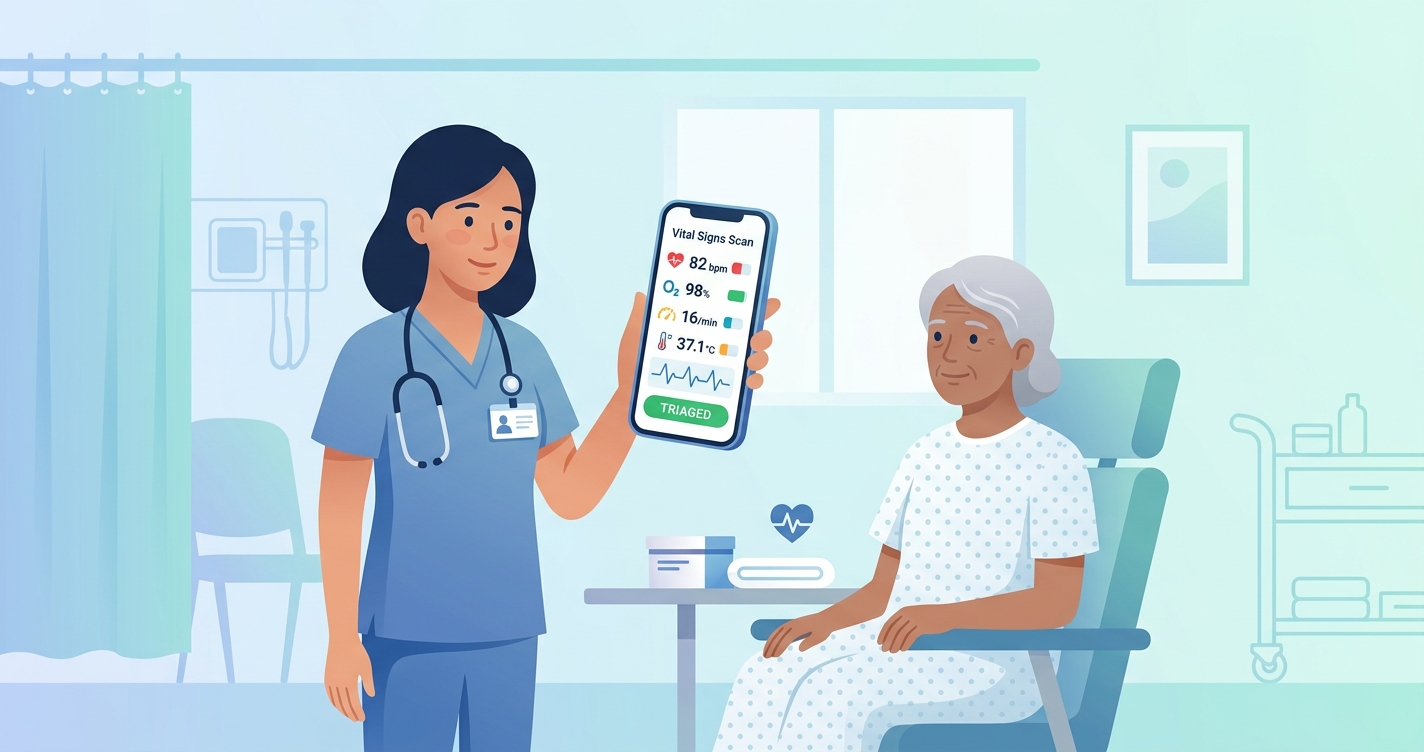
Nurses spend a surprising amount of their shift on tasks that aren't patient care. One of those tasks — taking and documenting vital signs — is ripe for a rethink. Phone-based vitals technology, which uses a smartphone camera to measure heart rate, respiratory rate, and other parameters without touching the patient, is starting to show up in triage workflows. For nurses dealing with overcrowded emergency departments and staffing gaps, the appeal is obvious: get a baseline reading faster, with less equipment, and move on to the patient who actually needs hands-on attention.
"A 2025 quality improvement study at Eastern Regional Referral Hospital in Bhutan found that incomplete vital signs documentation during triage was a persistent barrier to accurate patient prioritization, with initial compliance rates well below clinical standards." — Wangdi et al., BMJ Open Quality (2025)
Why triage vital signs matter more than most people realize
Triage is where nurses decide who gets seen first. In emergency departments, that decision hinges on vital signs — heart rate, blood pressure, respiratory rate, oxygen saturation, temperature. Miss one, document it late, or get a bad reading because the patient was moving, and you've degraded the entire prioritization system.
The problem is that traditional vitals capture during triage is equipment-heavy and time-consuming. A nurse needs a blood pressure cuff, a pulse oximeter, sometimes a thermometer, and they need the patient to sit still long enough to get clean readings. In a packed ED waiting room, that's not always realistic.
A 2025 study published in Frontiers in Cardiovascular Medicine by Sun et al. examined a patient-needs-enhanced nursing assessment framework in emergency settings. Their findings showed that structured, rapid assessment approaches — where nurses capture key physiological data early — cut time to critical interventions for chest pain patients. The mechanism was simple: faster data meant faster decisions.
Phone-based vitals fit into that same logic. (For broader context on where this technology sits, see our analysis of how contactless health monitoring is changing healthcare.) If a nurse can point a phone camera at a patient's face for 30 seconds and get heart rate, respiratory rate, and a stress indicator, that's one less trip to the supply cart and one less set of cables to untangle.
How phone-based vital signs capture works
The underlying technology is remote photoplethysmography, or rPPG. A smartphone camera records the patient's face and detects microscopic color fluctuations in the skin caused by blood flow. Each heartbeat pushes blood through facial capillaries, changing how the skin reflects light. The changes are too subtle for the human eye but readable by a phone's image sensor.
From that same video, algorithms extract respiratory rate by detecting the slight rhythmic chest and shoulder movements associated with breathing, along with heart rate variability patterns that indicate autonomic nervous system activity.
Shoushan et al. validated rPPG-derived heart rate measurements from smartphone cameras against reference-grade devices in a 2025 clinical study of 562 participants. They reported 99.1% heart rate accuracy with a mean absolute error of 2.96 bpm. A separate 2025 study in Frontiers in Digital Health confirmed similar accuracy for SpO2 measurements derived from rPPG, reinforcing the technology's reliability for health assessments.
For triage purposes, that level of accuracy provides a useful screening baseline. It won't replace a 12-lead ECG or an arterial blood gas, but it gives the triage nurse a quick physiological snapshot before deciding whether a patient needs immediate attention.
Traditional triage vitals vs phone-based vitals
| Factor | Traditional Vitals Capture | Phone-Based Vitals (rPPG) |
|---|---|---|
| Equipment needed | BP cuff, pulse oximeter, thermometer | Smartphone with app |
| Patient contact | Required (cuff inflation, finger clip) | Contactless (camera-based) |
| Time per patient | 3–5 minutes including setup | 30–60 seconds |
| Infection control | Equipment cleaning between patients | No shared equipment |
| Vitals captured | HR, BP, SpO2, temp, RR | HR, RR, HRV, stress index |
| Blood pressure | Direct measurement | Trend estimation (not diagnostic) |
| Temperature | Direct measurement | Not measured |
| Staff training | Moderate (equipment operation) | Minimal (app-based) |
| Documentation | Manual entry or device sync | Auto-populated to record |
| Cost per measurement | Consumables + equipment depreciation | Software license only |
| Portability | Cart or wall-mounted unit | Pocket-sized |
The tradeoffs are real. rPPG doesn't measure blood pressure with the same precision as an inflated cuff, and it can't take a temperature. But for an initial screen in a busy triage line, heart rate and respiratory rate are often the two most informative vitals for identifying patients who are deteriorating.
The documentation burden on nurses
This is where the story gets less about technology and more about what's happening to nurses right now. According to a 2025 KLAS Arch Collaborative report on nursing documentation burden, the paperwork load for nurses has expanded steadily as regulatory requirements have grown. The report found that excessive documentation is a direct contributor to burnout, with 40% of nurses surveyed indicating plans to leave the profession by 2029.
Cross Country's 2025 healthcare staffing survey reported that 65% of nurses experience high levels of stress and burnout, driven by unsafe staffing ratios, mandatory overtime, and the emotional weight of bedside care.
Anything that shaves time off a repetitive clinical task — like taking and recording vitals — gives nurses a few more minutes for the parts of their job that actually require human judgment. Phone-based vitals won't solve the staffing crisis, but they remove one friction point from a workflow that has too many of them.
Emergency department triage
In EDs running at capacity, triage nurses sometimes see 40 or more patients per shift. Each one needs at least a basic vital signs check before being assigned an acuity level. Phone-based vitals let the triage nurse do a rapid screen while the patient is still in the waiting room — before they've been moved to a bed, before equipment is available, before anything else happens.
A 2025 study published in JMIR by Jeon et al. examined using AI-driven tools in emergency department triage and found that technology-assisted triage improved consistency in prioritization. The implication for phone-based vitals is similar: giving nurses a quick data point early in the encounter improves the quality of their triage decision.
Urgent care and walk-in clinics
Urgent care settings often run lean on staff and equipment. A single nurse might handle intake for a dozen patients simultaneously. Phone-based vitals work well here because they don't require dedicated equipment stations — the nurse carries the tool in their pocket.
Home health and community nursing
Community health nurses working in patients' homes don't always have access to a full vitals cart. A phone-based tool means they can capture a baseline reading during a home visit without lugging extra equipment. This is particularly relevant for community health workers in resource-limited settings, where Circadify's rPPG technology has been deployed for smartphone-based screening.
Current research and evidence
The evidence base for rPPG in clinical contexts has grown substantially. A 2025 study published in Biomedical Engineering Online reviewed 145 articles on heart rate measurement using rPPG and deep learning approaches, cataloging improvements in accuracy across diverse populations and lighting conditions.
Research published in PubMed (2025) by teams studying pediatric populations found that rPPG-based heart rate and respiratory rate measurements showed promising agreement with reference devices, even in patient groups where traditional measurement is notoriously difficult — children don't sit still for blood pressure cuffs.
The ongoing clinical validation landscape includes a 2026 observational study registered on ClinicalTrials.gov evaluating rPPG-derived cardiovascular parameters against standard clinical measures in adults over 30. This kind of head-to-head validation against reference devices is what moves the technology from "interesting research" to "usable in clinical workflow."
What the research consistently shows is that rPPG performs well for heart rate and respiratory rate in controlled to semi-controlled conditions. It's less proven for blood pressure estimation and not yet positioned to replace full clinical vital signs panels. But for the triage use case — a quick screen to flag patients who need immediate attention — the accuracy is sufficient.
The future of phone-based vitals in nursing
The trajectory here is toward integration, not replacement. Phone-based vitals won't eliminate blood pressure cuffs or pulse oximeters from hospital supply closets. What they will do is give nurses an additional tool for situations where speed matters more than precision.
Integration with electronic health records is the next step. When a phone-based vital signs scan auto-populates the triage note, nurses skip the manual documentation step entirely. That's where the real time savings compound — not just in the measurement itself, but in the downstream paperwork.
Telehealth nursing is another growth area. Virtual triage nurses who assess patients via video call currently rely on patient self-reports for vital signs. If the patient can scan their own face during the video visit, the nurse gets objective data without asking the patient to find a blood pressure cuff they probably don't own.
Frequently Asked Questions
Can phone-based vitals replace a nurse's clinical assessment?
No. Phone-based vitals provide physiological data points, but triage is a clinical judgment that accounts for patient history, appearance, chief complaint, and context that no camera can capture. The technology assists the nurse's decision, it doesn't make the decision.
How accurate are phone-based vital signs compared to clinical monitors?
Published validation studies show heart rate accuracy within 2-3 bpm of reference devices and respiratory rate accuracy that tracks well with clinical measurement in controlled settings. Blood pressure estimation from rPPG is less precise than cuff-based measurement and is currently used for trend tracking rather than diagnostic readings.
Do patients accept having their vitals taken by a phone camera?
Early implementations suggest high patient acceptance, largely because the process is contactless and fast. Patients who are uncomfortable with cuff inflation or finger clips often prefer the camera-based approach. The 30-second scan time also reduces the feeling of being held up during a busy triage process.
What about privacy and data security?
The video feed is processed locally on the device — what's stored and transmitted is the extracted vital signs data, not the video itself. Clinical implementations follow the same HIPAA and data security standards as any other electronic health data capture.
The practical question for nursing workflows isn't whether phone-based vitals are perfect. It's whether they're good enough for the specific moment when a triage nurse needs to make a fast call about who gets seen next. Based on the current evidence, for heart rate and respiratory rate screening, the answer is increasingly yes. Tools like Circadify's contactless vitals platform are built for exactly this kind of rapid, equipment-free assessment — designed to fit into existing clinical workflows rather than overhaul them.