How Families Use Phone-Based Health Monitoring at Home
How families are adopting phone-based health monitoring at home to track vital signs, manage chronic conditions, and look after aging parents and children.
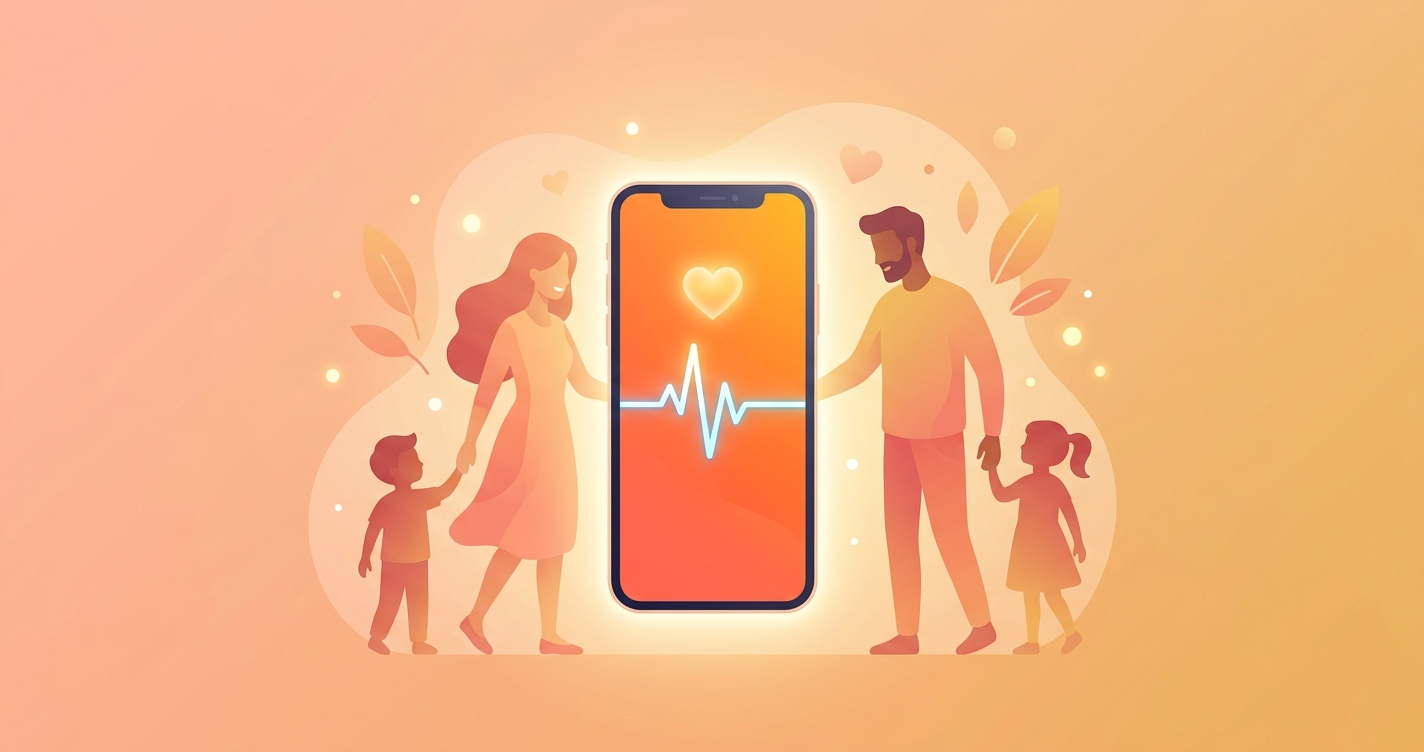
Families using phone health monitoring at home has become surprisingly ordinary. What started as a niche interest for fitness enthusiasts has quietly moved into kitchens and living rooms. Parents check their blood pressure after dinner. Grandparents do a quick camera scan before bed. Nobody thinks twice about it anymore. A 2024 Grand View Research report valued the mobile health app market at $37.5 billion, projecting growth to $86.37 billion by 2030 at a 14.8% compound annual growth rate. That kind of growth does not come from early adopters alone. It comes from regular households folding health monitoring into their daily lives.
"The most effective health interventions are the ones that fit into existing routines rather than creating new ones. When monitoring becomes as natural as checking the weather on your phone, adherence stops being a problem." — Dr. Eric Topol, Deep Medicine: How Artificial Intelligence Can Make Healthcare Human Again, 2019
Why Families Are Turning to Phone-Based Vital Signs Tracking
The shift toward home-based health monitoring did not happen overnight. Telehealth visits surged during the pandemic, and many families discovered that tracking basic vital signs between appointments gave them better information to share with their doctors. But the real friction point was always the hardware. Blood pressure cuffs, pulse oximeters, digital thermometers — each device requires batteries, calibration, and someone remembering where they put it.
Phone-based monitoring rewrites the whole setup. Remote photoplethysmography (rPPG) technology uses a smartphone's front-facing camera to detect subtle changes in skin color caused by blood flow, extracting heart rate, respiratory rate, heart rate variability, and blood oxygen estimates from a 30-second video. No cuffs, no clips, no Bluetooth pairing. The phone most family members already carry becomes the measurement device.
Pew Research Center's 2024-2025 data shows 97% of Americans under 50 own a smartphone, with 71% of all adults reporting near-constant use. For families trying to coordinate health tracking across multiple members and generations, the phone is the one device everyone already knows how to use.
The Multigenerational Monitoring Problem
Most families dealing with health monitoring are not tracking one person. They are tracking several, each with different needs. A grandmother with hypertension, a father recovering from surgery, a teenager with exercise-induced asthma, a child with a recurring fever pattern — each requires different measurements at different intervals. Traditional approaches meant buying separate devices and maintaining separate routines for each person.
Lau et al. (2020, Journal of Medical Internet Research) studied family health management patterns and found that households managing chronic conditions for multiple members reported an average of 2.7 separate monitoring devices. The study noted that device fatigue — the gradual abandonment of monitoring routines because the process is too cumbersome — was the primary reason families stopped tracking within six months.
A single-device approach, where each family member can run their own scan on the same phone, reduces this burden considerably. No one needs their own equipment. No one needs a tutorial on a new device. The 14-year-old can check their resting heart rate after track practice using the same app their grandmother uses to track her morning vitals.
Comparing Home Health Monitoring Approaches
| Method | Equipment Needed | Family Sharing | Ease of Use (Elderly) | Ease of Use (Children) | Data Centralization | Typical Cost |
|---|---|---|---|---|---|---|
| Traditional devices (cuffs, oximeters) | Multiple separate devices | Each person needs own device | Moderate — small screens, buttons | Low — poor fit, intimidating | Fragmented across devices | $50-200 per device |
| Wearable fitness trackers | Individual wearables per person | Each person needs own band | Low — charging, syncing issues | Moderate — sizing, durability | Per-person apps | $100-400 per person |
| Smart home sensors (ambient) | In-home hub, sensors | Shared by household | High — passive, no interaction | High — passive | Centralized but limited vitals | $200-500 setup |
| Phone-based camera scanning (rPPG) | Smartphone (existing) | One device, multiple users | High — familiar device, simple UI | Moderate-high — quick scan | Single app dashboard | Free to low-cost |
Comparison based on general consumer health technology categories as of 2025-2026.
The table makes one thing clear: phone-based scanning has the lowest barrier to entry for families because the hardware already exists in the household. The trade-off is that it requires active participation — someone has to hold the phone and sit still for 30 seconds — whereas ambient sensors work passively. But for most families, the active scan is a feature, not a bug. It creates a moment of intentional health awareness.
How Different Family Members Benefit
Parents Managing Children's Health
Pediatric health monitoring at home has always been tricky. Children are impatient with medical devices, finger clips slip off small fingers, and the "hold still" instruction works about as well as you would expect with a six-year-old. Phone-based scanning offers a less clinical alternative. A parent can frame a 30-second scan as a quick game rather than a medical procedure.
Respiratory rate tracking is particularly relevant for parents of young children. The American Academy of Pediatrics notes that respiratory rate changes are often the earliest indicator of illness in children, preceding fever by hours in many cases. Regular baseline tracking — say, a nightly scan as part of the bedtime routine — can reveal respiratory rate increases before other symptoms appear.
Bent et al. (2020, Journal of Medical Internet Research) found that consistent daily self-monitoring established stable personal baselines within 14 days for most individuals. For children, this means two weeks of evening scans gives parents a reliable reference point for what "normal" looks like for their specific child.
Adult Children Monitoring Aging Parents
This might be where phone-based monitoring matters most right now. Adult children worried about aging parents living independently face a constant tension: they want to know their parent is okay, but they do not want to install surveillance equipment in their mother's house or turn every phone call into a medical interrogation.
A simple daily scan routine — the parent does a 30-second camera scan each morning and the readings sync to a shared family dashboard — provides reassurance without intrusiveness. The parent maintains their independence and dignity. The adult child gets a data point that says "Mom's heart rate and respiratory rate were normal this morning" without having to ask.
Research published by the MDPI Sensors journal (2025) on engaging older adults in passive home monitoring found that seniors were significantly more receptive to monitoring technologies that used devices they already owned and understood. Smartphones ranked highest in acceptability, while dedicated medical devices and wearable sensors generated more resistance.
Managing Chronic Conditions Across the Household
For families where one or more members live with chronic conditions like heart failure, COPD, or hypertension, regular vital sign tracking is not optional — it is part of the treatment plan. Kivimaki and Steptoe (2018, Nature Reviews Cardiology) documented how consistent home monitoring improved outcomes for cardiovascular patients by catching deterioration early, before it became an emergency department visit.
The challenge is consistency. McEwen's concept of allostatic load — the cumulative physiological wear from chronic stress — applies to caregiver burden too. The family member responsible for health management accumulates their own health costs from the effort. Simplifying the monitoring process from "set up the cuff, wait for the reading, write it down, repeat for the next person" to "open app, scan, done" is not a trivial quality-of-life improvement for those families.
Current Research and Evidence
Camera-based vital sign measurement is well past the proof-of-concept stage at this point. A 2023 study on the medRxiv preprint server evaluated the WellFie application's rPPG technology against clinical-grade pulse oximetry and found strong correlation for heart rate measurement, with performance comparable to traditional contact-based PPG devices for cardiovascular monitoring.
A comprehensive review published in Sensors (2025) examined multi-modal contactless vital sign monitoring systems and documented the evolution from single-parameter extraction (heart rate only) to simultaneous measurement of heart rate, respiratory rate, SpO2, and blood pressure estimates from facial video. The review noted that accuracy within 1-2 BPM of clinical devices has been demonstrated across multiple independent studies.
Van Gastel et al. (2016) published early but foundational work showing rPPG-based respiratory rate extraction from RGB camera data with an RMSE of 2.67 breaths per minute, including successful testing on newborns in a neonatal intensive care unit. This matters for families because it demonstrates that the technology works across age groups — from infants to elderly adults — without requiring different hardware or calibration for each.
The Shaffer and Ginsberg (2017, Frontiers in Public Health) review established heart rate variability as a reliable non-invasive marker of autonomic nervous system function, measurable through camera-based methods. For families, HRV tracking adds a stress and recovery dimension beyond simple heart rate — a parent can notice when their own HRV trends downward during a stressful week and connect the data to how they have been feeling.
The Future of Family Health Monitoring at Home
Where is all this going? Ambient, continuous, and shared. Today, phone-based monitoring requires a deliberate 30-second scan. Tomorrow, it will likely integrate with video calls — checking a grandparent's vitals during a routine FaceTime conversation. Smart displays in common areas could passively capture vital signs as family members walk past. The data will aggregate into household health dashboards that flag anomalies across the whole family.
Privacy concerns will shape how fast this happens. Families will need to negotiate boundaries around who sees whose data, when alerts trigger, and how health information flows between generations. The technology is getting ahead of those conversations in many households.
The era of fragmented, device-heavy, single-user health monitoring at home is winding down. Families want something simpler. Phone-based monitoring built on rPPG technology is filling that gap, one 30-second scan at a time.
Solutions like Circadify are building toward this future, offering contactless vital sign scanning that works across age groups and use cases from a single smartphone app. For families looking to start a shared monitoring routine, the barrier to entry has never been lower.
Frequently Asked Questions
Can children use phone-based health monitoring safely?
Yes. Camera-based vital sign scanning is entirely passive — it uses reflected light from the skin, with no radiation, no physical contact, and no discomfort. Children old enough to sit still for 30 seconds (generally ages 4-5 and up) can complete a scan with parental assistance. Research by van Gastel et al. demonstrated successful rPPG measurement even on neonates, though those applications used dedicated cameras rather than smartphones.
How accurate is phone-based monitoring compared to traditional devices?
Multiple independent studies show camera-based heart rate measurement within 1-2 BPM of clinical pulse oximeters. Respiratory rate accuracy has been demonstrated at approximately 2-3 breaths per minute RMSE against reference devices. These accuracy levels are appropriate for home wellness monitoring and trend tracking, though they are not replacements for clinical diagnostic measurements.
Do all family members need their own phone or account?
Most rPPG-based apps allow multiple profiles on a single device. Each family member can have their own profile that stores their personal baseline data and tracks their trends independently. This means one household smartphone can serve as the monitoring device for the entire family.
What vital signs can phone-based monitoring actually measure?
Current rPPG technology can extract heart rate, respiratory rate, heart rate variability, blood oxygen saturation estimates, and stress indicators from a facial video scan. Some platforms also provide blood pressure estimates, though this measurement is still maturing in terms of accuracy compared to the other vital signs. The 30-second scan window captures enough cardiac cycles and respiratory patterns to produce reliable readings for the primary measurements.