5 Daily Health Metrics You Can Track Without a Wearable
Five daily health metrics you can track without a wearable device, using just a smartphone camera and rPPG technology for heart rate, HRV, respiratory rate, and more.
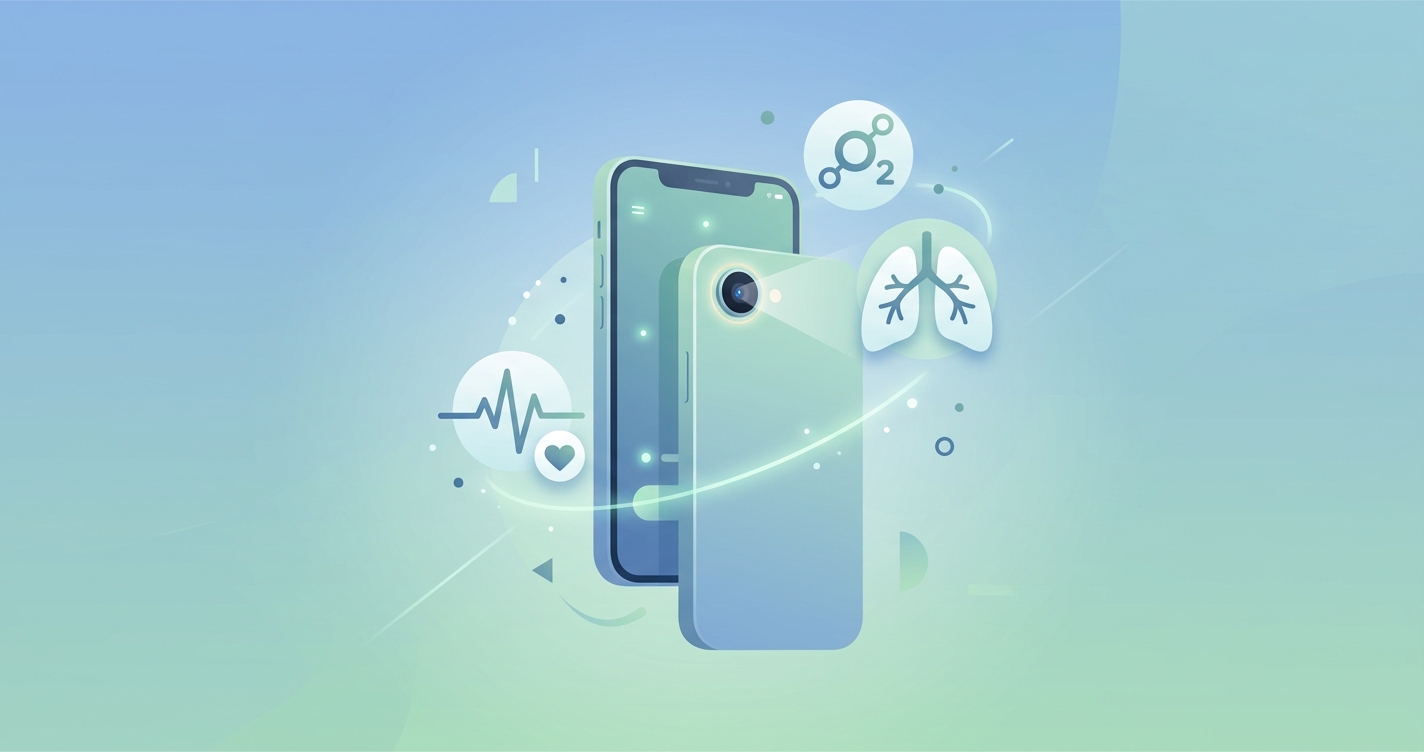
Most people assume that tracking daily health metrics requires a wearable on your wrist or a clip on your finger. That assumption made sense five years ago. It doesn't anymore. Remote photoplethysmography, or rPPG, has matured to the point where a smartphone camera can read several of the same vital signs that wearables capture, just by analyzing your face for about 30 seconds.
This isn't a future projection. A 2025 systematic review published in Frontiers in Digital Health reported that camera-based heart rate measurement achieved 99.1% accuracy compared to a pulse oximeter, and respiratory rate estimation reached 96% accuracy relative to a chest belt sensor. The technology works by detecting tiny fluctuations in skin color caused by blood flowing through capillaries beneath the surface. Your eyes can't see these changes. A camera sensor can.
"Smartphone-based monitoring of heart rate variability and resting heart rate predicts variability in symptom exacerbations in people with complex chronic illness." -- Aitken et al., New York University and Icahn School of Medicine at Mount Sinai, 2024
Here are five daily health metrics you can track without a wearable, what each one actually tells you, and where the science stands.
1. Resting heart rate
Resting heart rate is the most straightforward metric and the one with the longest research history. It tells you how hard your heart works when you're doing nothing, which turns out to be surprisingly informative about overall cardiovascular fitness.
A study in the European Heart Journal (Jensen et al., 2013) followed over 55,000 healthy adults for 16 years and found that each 10 bpm increase in resting heart rate was tied to a 16% increase in cardiovascular mortality risk. That held true even after adjusting for age, blood pressure, cholesterol, and physical activity. A separate longitudinal study in JAMA Internal Medicine (Nauman et al., 2011) confirmed that the trend of resting heart rate over time mattered as much as the absolute number.
For camera-based measurement, this is the most validated metric. The Frontiers in Digital Health review found that rPPG heart rate readings for values at or below 101 bpm correlated at 99.1% accuracy with pulse oximeter readings. At higher heart rates, accuracy decreases somewhat, but for resting measurements taken in reasonable lighting, the technology is reliable.
What to look for: track your resting heart rate first thing in the morning before coffee or activity. Consistent increases over weeks or months may signal deconditioning, chronic stress, or other changes worth paying attention to.
2. Heart rate variability
Heart rate variability, or HRV, measures the variation in time between consecutive heartbeats. A higher HRV generally signals better autonomic nervous system balance and greater physiological resilience. Lower HRV has been linked to chronic stress, inflammation, and elevated cardiovascular risk.
Aitken et al. at New York University and Icahn School of Medicine at Mount Sinai published research in 2024 showing that smartphone-based HRV monitoring predicted symptom variability in patients with complex chronic illness. The study used fingertip contact PPG rather than camera rPPG, but the underlying signal extraction is similar, and camera-based HRV estimation is catching up.
A 2025 medRxiv preprint from researchers using a Samsung Galaxy A22 front camera found that facial video-based HRV estimates correlated meaningfully with simultaneous 1-lead chest ECG recordings, though the authors noted that short recording windows (under 60 seconds) introduced more noise than longer sessions.
| Metric | What it measures | Wearable method | Camera-based method | Current accuracy |
|---|---|---|---|---|
| Resting heart rate | Beats per minute at rest | Wrist optical sensor | Facial skin color changes via rPPG | ~99% vs. pulse oximeter |
| Heart rate variability | Beat-to-beat timing variation | Chest strap or wrist PPG | Facial rPPG signal analysis | 0.9 Pearson correlation |
| Respiratory rate | Breaths per minute | Chest belt sensor | Chest/shoulder motion + rPPG modulation | ~96% vs. chest belt |
| Blood oxygen trends | Hemoglobin oxygen saturation | Fingertip pulse oximeter | Facial color channel analysis | Research-stage, improving |
| Stress index | Autonomic nervous system balance | HRV-derived from wrist | HRV-derived from facial rPPG | Correlates with validated scales |
The practical takeaway: HRV is best measured in consistent conditions, such as the same time each morning, sitting in the same position. Single readings fluctuate a lot. The value comes from observing your personal baseline and how it shifts over weeks.
3. Respiratory rate
Respiratory rate gets overlooked in the self-tracking conversation, which is strange given how clinically relevant it is. Abnormal breathing patterns are among the earliest indicators of physiological distress, and respiratory rate has been called "the neglected vital sign" in clinical literature because it's so often skipped even in hospital settings.
Camera-based respiratory rate estimation works through two mechanisms. The first is detecting the subtle rise and fall of the chest and shoulders in a video frame. The second is reading respiratory-induced modulation of the rPPG signal itself, since breathing affects venous return and blood volume in a cyclical pattern that shows up in the facial color signal.
The Frontiers in Digital Health review reported 96% accuracy (within 6.9 breaths per minute) for camera-based respiratory rate compared to a chest belt sensor. That's a meaningful margin of error for clinical applications, but for daily self-tracking purposes, it's informative enough to detect whether your breathing rate is trending in the right direction.
Normal adult respiratory rate at rest falls between 12 and 20 breaths per minute. Consistently elevated rates can indicate anxiety, respiratory illness, metabolic changes, or cardiovascular strain. Rates below 12 are unusual in healthy adults and may warrant attention.
4. Blood oxygen saturation trends
This is the metric where I'd urge the most caution about over-interpreting camera-based results. SpO2 measurement via smartphone camera is real and has been validated in controlled conditions, but it's less mature than heart rate or respiratory rate estimation for contactless, camera-only approaches.
A study published in npj Digital Medicine (Nature, 2022) tested smartphone camera oximetry during induced hypoxemia and found that a trained model could predict SpO2 across clinically relevant levels (70-100%). However, the study used fingertip contact with the camera flashlight, not contactless facial scanning. Fully contactless SpO2 from facial video is an active area of research, with a 2025 paper on arXiv proposing an end-to-end deep learning framework combining video data with color calibration.
The gap between controlled research and real-world consumer use is wider here than for heart rate. Lighting conditions, skin tone, camera quality, and distance from the lens all affect accuracy more for oxygen saturation than for pulse estimation.
That said, for daily tracking purposes, what matters is relative trends, not absolute numbers. If your camera-based readings show a consistent downward trend over several days, that's a signal to check in with a medical-grade device or your doctor, not to diagnose anything from the phone reading alone.
5. Stress index
Stress measurement from a camera might sound like it belongs in a wellness app gimmick category, but the underlying science is more grounded than the marketing around it. The stress index is typically derived from HRV analysis, specifically looking at the ratio between sympathetic and parasympathetic nervous system activity.
Research published in Cognitive Computation (2023) reviewed the state of stress prediction from HRV using artificial intelligence and found that smartphone-collected physiological data, including HRV, could meaningfully differentiate stress states. A separate 2025 study in PMC demonstrated that PPG-based HRV analysis combined with machine learning could distinguish between rest and stress conditions during Stroop tasks, with statistically significant differences in SDNN (a time-domain HRV measure) between stress and rest periods.
The camera-based approach works by extracting HRV from the facial rPPG signal and then computing stress-related indices from it. The signal chain is longer than for simple heart rate, which means more potential for noise, but in consistent conditions the relative measurements track well against validated stress scales.
How these five metrics connect
These metrics aren't independent of each other. Chronic stress typically shows up as elevated resting heart rate, reduced HRV, slightly increased respiratory rate, and a higher stress index, all at once. That redundancy is actually useful. If three out of five metrics shift in the same direction over the same period, that convergence tells you something meaningful about your overall physiological state.
How camera-based health tracking compares to alternatives
The usual comparison is against wrist-worn wearables, but it's worth thinking about why someone might prefer the camera approach even when wearables are available.
Compliance and consistency
Wearable fatigue is a documented phenomenon. A 2023 survey by Rock Health found that nearly half of people who purchased a fitness wearable stopped using it within six months. The charging cycle, skin irritation, fashion concerns, and general forgetfulness all contribute to dropout. A phone camera scan takes 30 seconds, doesn't require remembering to charge or wear anything, and can be integrated into an existing morning routine with zero additional hardware.
Accessibility
Not everyone can afford or wants to wear a smartwatch. Phone-based health scanning reaches a much wider population. This is especially relevant in lower-income populations and emerging markets where smartphones are ubiquitous but wearable adoption is low.
Limitations to be honest about
Camera-based methods can't do continuous monitoring. You get a snapshot, not a stream. Wearables track you all night and all day. If you need sleep staging, step counting, or continuous heart rate during exercise, a wearable still wins. The camera approach is better suited for deliberate daily check-ins rather than passive data collection.
Current research and evidence
The research base for camera-based vital sign measurement has grown rapidly since 2020. A few studies that frame the current state:
The Frontiers in Digital Health systematic review (2025) is the most comprehensive recent assessment. It analyzed multiple rPPG studies and reported correlations of 0.9 (Pearson) for HRV and 99.1% accuracy for heart rate at normal resting values. The review noted that respiratory rate and SpO2 estimation need further validation, particularly across diverse skin tones and lighting conditions.
Researchers at Real-World Testing Reveals Limits of Contact-Free Heart Rate Monitoring (CardioCare Today, December 2025) documented that rPPG accuracy degrades under motion artifacts and poor lighting, which aligns with what most researchers in the field acknowledge. The technology works best when the subject is sitting still in reasonable indoor lighting.
The contact-PPG research from NYU and Mount Sinai (Aitken et al., 2024) demonstrated clinical utility for smartphone-based vital sign monitoring in chronic illness populations, adding evidence that these metrics carry genuine prognostic value when tracked longitudinally.
The future of wearable-free health tracking
Camera-based health monitoring is following a trajectory similar to what happened with smartphone photography. Early phone cameras were novelties. Now they've replaced point-and-shoot cameras for most people. The same compression is happening in health sensing, where the phone's existing hardware is absorbing functions that previously required separate devices.
Two trends are accelerating this. First, phone cameras keep getting better: higher frame rates, larger sensors, and improved low-light performance all directly benefit rPPG accuracy. Second, on-device machine learning is making real-time signal processing possible without sending video to the cloud, which addresses privacy concerns that have slowed adoption.
Within the next few years, expect camera-based health checks to become a standard feature in telehealth visits, insurance applications, and daily wellness routines. Companies like Circadify are building the infrastructure for this, with rPPG technology that runs on standard smartphones.
Frequently asked questions
How accurate is phone-based health tracking compared to a wearable?
For resting heart rate, camera-based methods are very close to wearable accuracy, with studies showing 99.1% agreement with pulse oximeters. HRV correlations reach 0.9 against clinical ECG. Respiratory rate is accurate within about 7 breaths per minute. SpO2 is still maturing for contactless approaches. The gap varies by metric, but for daily trend tracking, camera methods are practical for most people.
Do I need special lighting or a specific phone?
Reasonable indoor lighting works fine. Direct sunlight or very dim rooms reduce accuracy. Most modern smartphones with front-facing cameras of 720p or higher resolution are capable. Higher frame rates (30 fps or above) produce better results. You don't need the latest flagship phone.
Can camera health scans replace a doctor's visit?
No. Camera-based metrics are useful for daily self-tracking and spotting trends, but they aren't diagnostic tools. If your metrics show concerning patterns, see a healthcare provider with clinical-grade equipment. Think of camera scans as a regular check-in that helps you know when to seek professional evaluation.
Is my face video stored or shared?
This depends on the specific app you use. Many rPPG applications process video entirely on-device and never transmit facial footage. Check the privacy policy of any health scanning app before use. On-device processing has become the industry norm for privacy-conscious implementations.
If you're interested in trying camera-based health tracking, Circadify offers a smartphone app that measures multiple vital signs from a 30-second face scan, no wearable required.