
How Companies Are Building Products With Circadify Technology
How companies across telehealth, insurance, and wellness are building products with Circadify rPPG technology to add contactless vitals to their platforms.
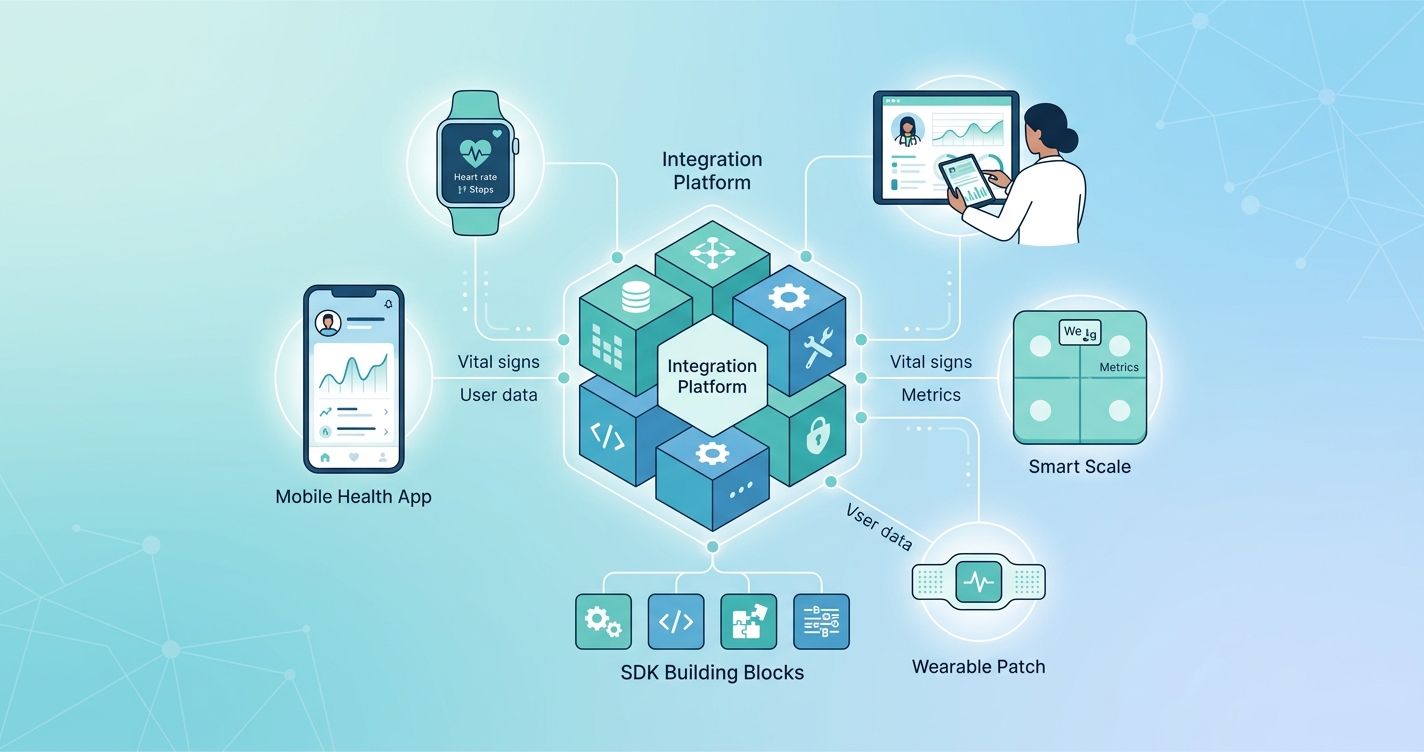
Companies building products with Circadify technology span a wider range of industries than most people expect. What started as a consumer-facing vitals app has become an SDK and API platform that other organizations embed into their own products, from telehealth platforms measuring patient vitals during video calls to insurance carriers replacing paramedical exams with a 30-second phone scan. The shift from standalone app to embeddable infrastructure is reshaping how contactless health monitoring reaches end users.
"Remote photoplethysmography is an emerging healthtech sub-sector to watch in 2024 and 2025, with its contactless nature making it ideal for telehealth consultations and remote patient monitoring." — Healthcare Digital, 2024
Why companies are integrating rPPG rather than building it
Building a reliable rPPG engine from scratch is expensive and slow. The signal processing pipeline alone, extracting cardiovascular data from subtle changes in facial skin color captured by a phone camera, requires expertise in computer vision, digital signal processing, and physiological modeling. A 2024 analysis by Healthcare Digital noted that the underlying technology demands years of algorithm refinement across diverse skin tones, lighting conditions, and camera hardware before it performs consistently in real-world settings.
Most product teams don't have that runway. A telehealth company wants to add vitals capture to its video visit experience. An insurance carrier wants to eliminate the nurse visit from its underwriting process. A corporate wellness provider wants biometric screening without sending a van to every office. None of them want to spend three years building signal processing algorithms.
That's where SDK integration comes in. Companies embed a pre-built rPPG engine into their own applications, adding contactless vital sign measurement without rebuilding the core technology. The approach mirrors how companies use Stripe for payments or Twilio for messaging rather than building those systems internally.
The market driving this shift
The vital signs monitoring devices market was valued at $11.56 billion in 2025 and is projected to reach $25.58 billion by 2035, according to Precedence Research, growing at a compound annual growth rate of 8.27%. SNS Insider published a separate estimate in September 2025 pegging the 2024 market at $8.05 billion, with a projection of $16.42 billion by 2032. Regardless of whose numbers you trust, the trajectory points in one direction.
What's changed is the delivery mechanism. Traditional vital signs monitoring required dedicated hardware: pulse oximeters, blood pressure cuffs, ECG patches. Camera-based measurement eliminates the hardware dependency entirely, which opens the door for software companies that never would have entered the vitals space.
| Integration approach | Hardware required | Time to deploy | Scalability | Cost per measurement |
|---|---|---|---|---|
| Traditional devices (cuffs, oximeters) | Yes, per patient | Weeks to months | Limited by device inventory | $5-50 per reading |
| Wearable patches/bands | Yes, per patient | Days to weeks | Limited by device distribution | $2-20 per reading |
| Camera-based rPPG SDK | No, uses existing cameras | Days | Unlimited, software only | Negligible marginal cost |
| Custom-built rPPG engine | No, but requires R&D team | 2-3 years | Unlimited once built | High fixed cost, low marginal |
Where companies are putting the technology to work
Telehealth and virtual care
The most natural fit. During a video visit, the patient is already facing a camera. Adding vitals capture to that existing interaction requires no behavioral change from the patient and no additional hardware. Telehealth platforms that have integrated rPPG can measure heart rate, respiratory rate, and stress indicators while the clinician conducts the consultation.
A 2024 report from Healthcare Digital highlighted that rPPG's contactless nature makes it particularly suitable for telehealth, especially in underserved areas where patients may not have access to traditional monitoring equipment. The report noted that real-time health data from rPPG could enable more informed clinical decisions during remote consultations.
Insurance underwriting
Life insurance has historically required a paramedical exam, where a nurse visits the applicant's home, draws blood, measures vitals, and sends samples to a lab. The process takes weeks and costs carriers $100-200 per exam. Several insurance carriers and insurtechs have begun exploring camera-based vitals as a replacement for or supplement to that process.
The appeal is straightforward: an applicant opens an app, scans their face for 30 seconds, and generates a vitals profile that feeds directly into underwriting algorithms. Accelerated underwriting programs that once relied solely on prescription history databases and MIB records can now incorporate actual biometric measurements.
Corporate wellness and biometric screening
Annual biometric screenings at large employers typically involve setting up stations in conference rooms, hiring nurses, and processing hundreds of employees through blood draws and cuff measurements over several days. Camera-based vitals allow the same data collection through an app that employees use on their own phones, on their own schedule.
The shift from event-based screening to continuous or on-demand measurement also changes the data picture. Instead of a single annual snapshot, companies get longitudinal health trends that wellness programs can actually act on.
Clinical kiosks and waiting rooms
Hospitals and clinics are embedding rPPG into check-in kiosks and patient intake tablets. A patient arriving for an appointment sits in front of a screen for 30 seconds during registration and has baseline vitals recorded before they ever see a clinician. Retail Systems reported in 2025 that healthcare automation through kiosks is gaining traction, with fanless thermal designs meeting sterile environment standards for hospital deployment.
The rPPG vendor landscape
Several companies now offer rPPG SDKs at various stages of maturity and regulatory status.
FaceHeart, based in Taiwan, received FDA clearance for its Vitals SDK, which measures heart rate, respiratory rate, blood pressure, SpO2, and heart rate variability through a facial scan. Applied Radiology covered the clearance in 2025, noting it was the first FDA-cleared SDK solution for contactless video-based vital sign measurement.
Shen AI, based in the Czech Republic, offers an SDK that tracks over 30 health markers through a smartphone camera. Their platform targets both consumer health apps and enterprise integrations.
Darwin Edge provides a remote vital signs monitoring solution built on rPPG, with a focus on clinical and research applications.
Circadify has developed a full-stack rPPG platform covering consumer apps, enterprise SDKs, and white-label solutions. The technology measures heart rate, respiratory rate, SpO2, blood pressure, and stress through a standard phone camera.
Each vendor makes different tradeoffs around accuracy, regulatory status, supported vitals, integration complexity, and pricing model. Companies evaluating which SDK to embed typically run pilot programs comparing performance against reference-grade medical devices before committing to a production integration.
| Vendor | Primary market | Regulatory status | Vitals measured | Integration model |
|---|---|---|---|---|
| FaceHeart | Clinical, enterprise | FDA cleared | HR, RR, BP, SpO2, HRV | SDK |
| Shen AI | Consumer, enterprise | CE marked | 30+ markers | SDK, API |
| Darwin Edge | Clinical, research | Research stage | HR, RR, HRV | API |
| Circadify | Full-stack (consumer to enterprise) | In progress | HR, RR, BP, SpO2, stress | SDK, API, white-label |
Current research and evidence
The scientific foundation for camera-based vitals measurement has been building for nearly two decades. Verkruysse, Svaasand, and Nelson published the foundational rPPG paper in Optics Express in 2008, demonstrating that cardiovascular signals could be extracted from ordinary video. Poh, McDuff, and Picard at MIT extended this work in 2010 and 2011, showing reliable heart rate extraction from webcam video using independent component analysis.
More recent work has focused on robustness across diverse conditions. Di Lernia et al. published a study in Behavior Research Methods in 2024 showing that modern rPPG algorithms extract reliable heart rate measurements from webcam footage in uncontrolled home environments, not just laboratories. Wang et al. developed the Plane-Orthogonal-to-Skin algorithm, published in IEEE Transactions on Biomedical Engineering in 2017, which improved accuracy across different skin tones and lighting conditions.
The gap between lab performance and field performance has been the primary obstacle to commercial deployment. Each year of algorithm improvement narrows that gap, which is why companies are increasingly comfortable embedding rPPG into production healthcare applications rather than treating it as an experimental feature.
The future of SDK-driven health integration
The pattern of companies building products with Circadify technology and similar rPPG platforms follows a trajectory we've seen in other infrastructure technologies. Early adopters are telehealth and insurance, where the business case is clearest. Next come corporate wellness, clinical kiosks, and remote patient monitoring. Eventually, the technology becomes a background capability in any application with camera access.
Precedence Research's projection of a $25.58 billion vital signs monitoring market by 2035 reflects not just growth in traditional devices but the entrance of entirely new product categories. Software companies that never sold medical devices are now offering vital sign measurement as a feature within their existing platforms.
The regulatory landscape will shape adoption speed. FaceHeart's FDA clearance for its SDK set a precedent that other vendors will follow. As more SDKs achieve regulatory clearance for clinical use, the addressable market expands from wellness applications (where regulatory barriers are lower) into clinical diagnostics and reimbursable remote patient monitoring.
Frequently asked questions
How long does it take to integrate an rPPG SDK into an existing application?
Most SDK providers report integration timelines of days to a few weeks, depending on the complexity of the host application and the depth of customization required. The core integration is typically a few hundred lines of code that activate the camera, run the measurement, and return results through an API.
Do companies need special cameras or hardware?
No. rPPG works with standard cameras found in smartphones, tablets, laptops, and webcams. The SDK handles all the signal processing on the device's existing hardware. This is one of the primary reasons companies choose camera-based vitals over traditional monitoring equipment.
What vitals can camera-based SDKs currently measure?
Current generation SDKs typically measure heart rate, respiratory rate, heart rate variability, and blood oxygen saturation. Some vendors also offer blood pressure estimation and stress scoring. The specific vital signs available vary by vendor and by the regulatory clearance status of each measurement.
Is the technology accurate enough for clinical use?
Accuracy depends on the specific vital sign, the algorithm, and the measurement conditions. Heart rate measurement via rPPG has reached near-clinical accuracy in controlled conditions, with mean absolute errors below 3 BPM in multiple peer-reviewed studies. Other measurements like blood pressure are less mature. Companies typically validate SDK performance against reference devices during pilot programs before deploying clinically.
The companies building products on top of contactless vitals platforms are creating a new category of health-enabled software. Circadify's SDK and API platform is one entry point into this space, designed for organizations that want to add camera-based vital sign measurement to their existing products without building the underlying technology. To explore how Circadify's platform fits into your product roadmap, visit circadify.com.