
Camera-Based Health Applications: The Growing Ecosystem
The camera based health applications ecosystem is expanding fast across telehealth, insurance, wellness, and consumer health. Here's where things stand in 2026.
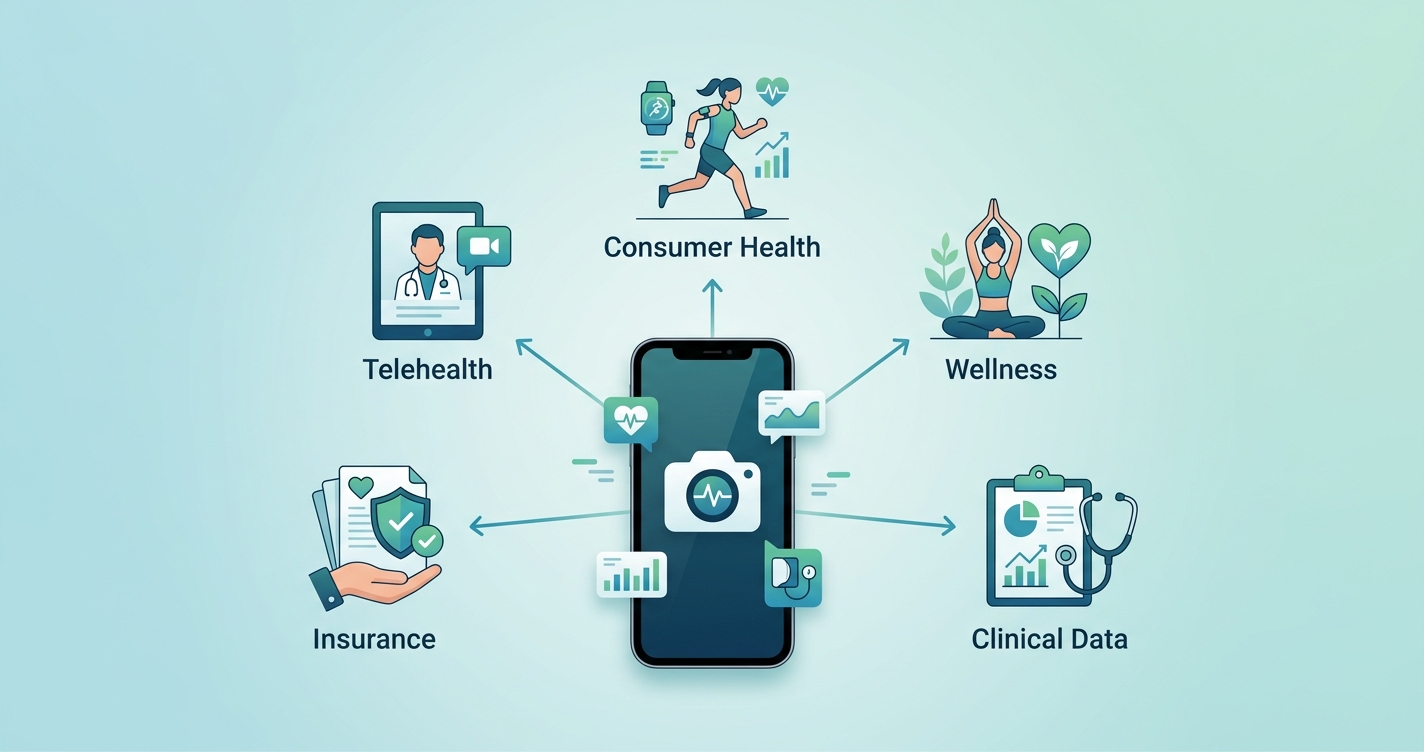
The camera based health applications ecosystem looked very different two years ago. Back then, the concept of measuring heart rate, respiratory rate, or blood oxygen through a phone camera felt experimental, something researchers published papers about but nobody shipped to real users at scale. That's changed. In 2026, camera-based health measurement has spread into telehealth platforms, insurance underwriting workflows, corporate wellness programs, and consumer apps that millions of people use on their phones every week.
"Remote photoplethysmography is not a single application. It is a platform technology, and we are only beginning to see the variety of products that can be built on top of it." — Dr. Gerard de Haan, Philips Research, whose CHROM and POS algorithms remain foundational to most modern rPPG implementations
How camera-based health measurement actually works
The core technology behind this ecosystem is remote photoplethysmography, or rPPG. A phone camera captures video of a person's face for 15 to 60 seconds. Beneath the skin, blood volume changes with each heartbeat, and those changes produce tiny fluctuations in reflected light that are invisible to the eye but detectable by a camera sensor. Signal processing algorithms extract cardiovascular data from those fluctuations.
The technique was first demonstrated by Verkruysse, Svaasand, and Nelson in a 2008 paper published in Optics Express, using a simple consumer webcam and ambient light. Since then, researchers have developed increasingly robust algorithms. De Haan and Jeanne introduced the CHROM method in 2013, and De Haan and Van Leest published POS (Plane-Orthogonal-to-Skin) in 2014. Both papers came out of Philips Research and are still referenced in most commercial implementations.
A 2025 review published in Frontiers in Digital Health by researchers associated with IntelliProve surveyed the current state of rPPG-based health assessment and found that the technology now supports measurement of heart rate, heart rate variability, respiratory rate, blood oxygen saturation, blood pressure estimation, and stress indicators. The review noted that real-world deployment still requires careful handling of lighting variation, skin tone diversity, and motion artifacts, but that commercial systems have made meaningful progress on all three fronts.
The ecosystem by sector
The camera based health applications ecosystem isn't one market. It's several markets that happen to share the same underlying technology. Each sector uses rPPG differently, and the products that get built look nothing alike.
| Sector | What camera vitals replace | Primary users | Maturity in 2026 |
|---|---|---|---|
| Telehealth | Patient-reported symptoms, no vitals during video calls | Telehealth platforms, health systems | Commercial deployments active |
| Life insurance | Paramedical exams, nurse visits | Carriers, MGAs, insurtechs | Pilot and early commercial |
| Corporate wellness | Onsite biometric screening events | HR, benefits consultants | Commercial deployments active |
| Consumer health | Separate pulse oximeters, fitness bands | Individual users | Widely available |
| Remote patient monitoring | Wearable devices for chronic care | Hospitals, care management orgs | Pilot stage |
| Automotive | No driver vitals monitoring existed | OEMs, Tier-1 suppliers | R&D and early integration |
| Fraud/deepfake detection | Software-only liveness checks | Identity verification, fintech | Emerging |
Telehealth
Before camera-based vitals, a telehealth visit was essentially a phone call with video. The doctor could see you but had no objective health data unless you owned a blood pressure cuff or pulse oximeter and read the numbers out loud. Camera-based vitals change that equation. The patient's phone captures heart rate, respiratory rate, and oxygen saturation during the visit itself, and that data flows directly into the clinical record.
PanopticAI, a Hong Kong-based company, received FDA clearance for its mobile app for contactless pulse rate monitoring, making it one of the first camera-based health tools to clear the regulatory bar in the U.S. market. Their Vitals SDK is designed to be embedded in third-party telehealth platforms.
Insurance underwriting
The insurance industry has a specific, expensive problem that camera-based health applications solve. Traditional life insurance underwriting requires a paramedical exam where a nurse visits the applicant's home, draws blood, measures vitals, and sends samples to a lab. The process takes weeks and costs $100 to $200 per applicant. Many applicants simply abandon the application before the exam happens.
RGA, one of the world's largest reinsurers, published a detailed analysis of PPG solutions for insurance in 2025. The report explored how smartphone camera technology could gather health metrics during the application process, potentially replacing or supplementing traditional paramedical exams. RGA noted that while large-scale clinical validation studies are still limited, the technology offers a path to "instant-issue" policies where applicants get coverage decisions in minutes rather than weeks.
Corporate wellness
Corporate biometric screening has traditionally meant hiring a vendor to send nurses to office locations for a day of blood draws and vitals measurements. It's expensive, logistically painful, and participation rates are often low because employees have to show up at a specific time and place. Phone-based vitals screening lets employees complete their biometric check from home on their own schedule.
Consumer health
This is where most people first encounter camera-based vitals. Consumer apps let anyone measure their heart rate by holding their phone up to their face for 30 seconds. The category has grown quickly since 2023, and app stores now have dozens of options. The consumer segment matters to the broader ecosystem because it generates awareness and comfort with the technology, which makes adoption easier in professional settings.
Market size and growth trajectory
The numbers tell the story of where investment is flowing. The contactless vital signs monitoring market was valued at $1.3 billion in 2024 and is projected to reach $4.5 billion by 2035, growing at a compound annual growth rate of 12.3%, according to WiseGuy Reports. That's the contactless-specific slice.
The broader vital signs monitoring devices market provides additional context. Precedence Research valued it at $11.56 billion in 2025, projecting $25.58 billion by 2035 at a CAGR of 8.27%. SNS Insider published a separate estimate in September 2025 pegging the 2024 market at $8.05 billion, with a projection of $16.42 billion by 2032 at a CAGR of 8.32%. DelveInsight estimated $8.45 billion in 2024, reaching $14.99 billion by 2032 at 7.48%.
The numbers vary across research firms, but the direction is consistent: high single-digit to low double-digit annual growth, with contactless methods growing faster than the overall category.
| Source | 2024/2025 value | Projected value | CAGR | Forecast period |
|---|---|---|---|---|
| WiseGuy Reports (contactless only) | $1.3B (2024) | $4.5B | 12.3% | 2025-2035 |
| Precedence Research (all vital signs devices) | $11.56B (2025) | $25.58B | 8.27% | 2026-2035 |
| SNS Insider (all vital signs devices) | $8.05B (2024) | $16.42B | 8.32% | 2025-2032 |
| DelveInsight (all vital signs devices) | $8.45B (2024) | $14.99B | 7.48% | 2025-2032 |
Current research and evidence
The academic research pipeline behind rPPG is active and producing results that matter for commercial applications.
A 2025 paper from arXiv (arXiv:2504.01774v2) introduced ME-rPPG, a method for predicting cardiovascular signals from facial video. The researchers outlined future work extending the approach to blood oxygen and blood pressure estimation, and explored multimodal fusion with thermal imaging and IMU sensors to improve accuracy. This line of research matters because it addresses the gap between what rPPG can measure today (heart rate is well-established) and what the market wants it to measure (blood pressure, SpO2, and more complex biomarkers).
A separate 2025 study published in PMC examined the reliability of rPPG under low-light conditions and high heart rate scenarios. The researchers found that elevated heart rate conditions remain a limitation for practical deployment, particularly in telehealth settings where patients may be anxious or in distress. The study was part of the CHILL benchmark initiative, which aims to standardize testing conditions for rPPG systems.
Peter Charlton at the University of Cambridge has published extensively on photoplethysmography devices, including a chapter reviewing wearable and camera-based PPG applications that spans clinical use, fitness monitoring, and lifestyle tracking. His work provides a useful taxonomy of the application categories that camera-based health measurement is moving into.
What's next for camera-based health applications
The near-term trajectory of this ecosystem depends on a few things happening simultaneously. Regulatory clearances will determine which applications can make clinical claims. The FDA clearance for PanopticAI's pulse rate monitoring is a data point, but clearances for blood pressure and SpO2 measurement would open much larger market segments.
Algorithm improvement is the other bottleneck. The 2025 research on ME-rPPG and the CHILL benchmark studies both point toward the same conclusion: rPPG works well for heart rate under controlled conditions, and the research community is working on extending that reliability to more vital signs under messier real-world conditions.
The insurance and telehealth sectors are likely to drive the most commercial adoption in the next two years. Both have clear economic incentives (eliminating paramedical exams, adding vitals to video visits) and both are already running pilots or early deployments.
Consumer apps will continue to grow as the entry point for most people's first contact with the technology. And more specialized applications, like driver monitoring in vehicles and deepfake detection through liveness verification, will develop on their own timelines.
Frequently asked questions
What vital signs can camera-based apps measure?
Current camera-based health applications can measure heart rate, heart rate variability, respiratory rate, and stress indicators with reasonable accuracy. Blood oxygen saturation (SpO2) and blood pressure estimation are available in some implementations but are still being validated through clinical studies. Heart rate measurement is the most mature and widely validated capability.
Are camera-based health measurements accurate enough for medical use?
It depends on the specific measurement and the application. Heart rate measurement via rPPG has been studied extensively and performs well under controlled conditions. Blood pressure estimation is less mature. Regulatory clearances, like the FDA clearance received by PanopticAI for pulse rate monitoring, are beginning to establish the clinical credibility of specific implementations. Each application needs to be evaluated on its own evidence.
How is camera-based health monitoring different from a smartwatch?
A smartwatch uses contact-based photoplethysmography, where an LED shines light through the skin of your wrist and a sensor reads the reflected light. Camera-based rPPG does something similar but at a distance, using ambient light reflected from the face. The practical difference: you don't need to buy or wear a device. You use the phone you already have. The tradeoff is that camera-based methods are more sensitive to lighting, movement, and other environmental factors.
Which industries are adopting camera-based health applications fastest?
Telehealth and insurance are the furthest along in commercial adoption. Telehealth platforms see camera vitals as a way to add clinical value to video visits. Insurance carriers see it as a way to eliminate expensive paramedical exams. Corporate wellness is also moving quickly, replacing onsite biometric screening events with phone-based alternatives. Consumer health apps are widely available but tend to be standalone rather than integrated into larger workflows.
The camera based health applications ecosystem is growing because the underlying technology, rPPG, is finally mature enough to ship in real products across multiple industries. If you're interested in trying contactless vitals measurement yourself, Circadify offers a phone-based health scanning experience that captures heart rate, respiratory rate, and other vitals in about 30 seconds, no additional devices required.