How Athletes Use Camera-Based Vitals for Recovery Tracking
How athletes and sports teams use camera-based rPPG technology to track recovery through heart rate variability, resting heart rate, and contactless vital sign monitoring.
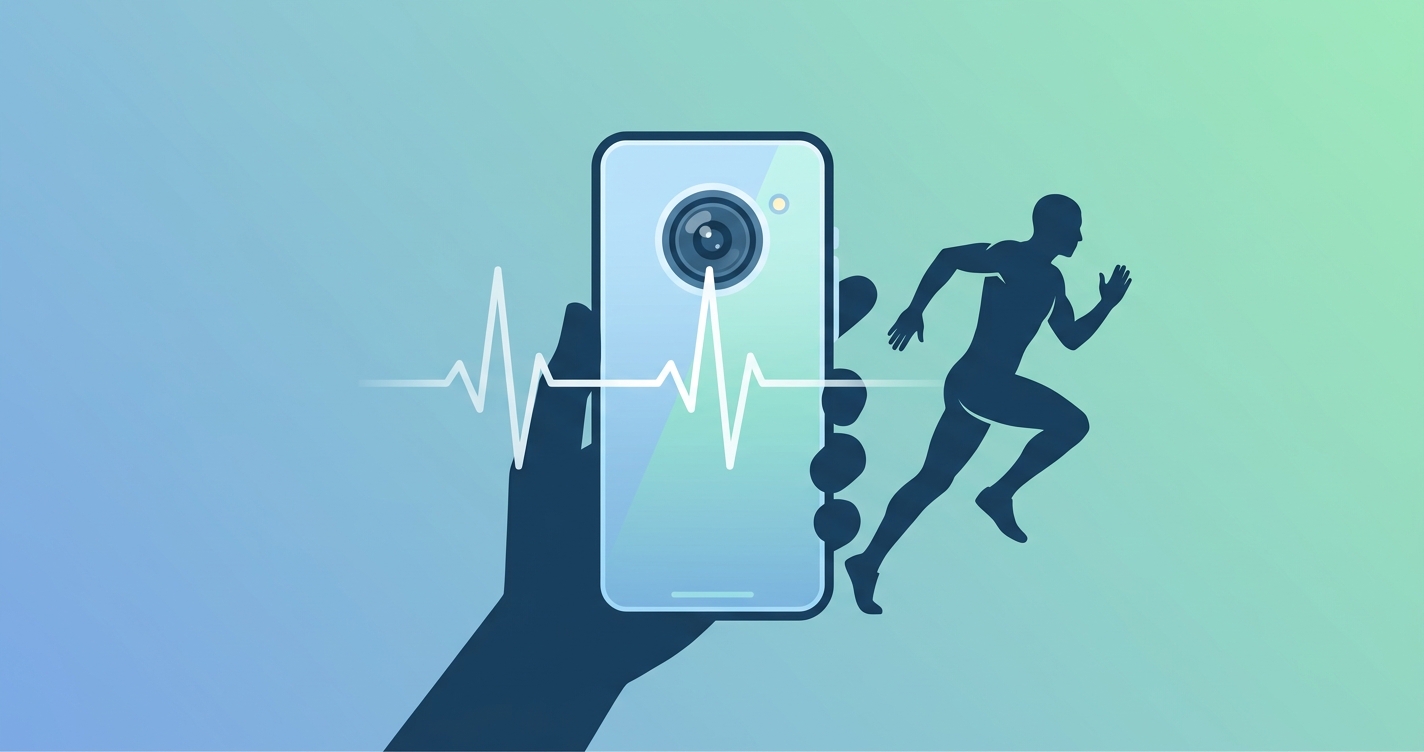
Recovery has quietly become the defining edge in competitive athletics. Training hard is table stakes. The athletes and teams pulling ahead are the ones who recover smarter, and that means measuring what's actually happening inside the body between sessions. Heart rate variability, resting heart rate, respiratory rate — these are the biomarkers that tell a coach whether an athlete is ready to push or needs another day. The problem has always been getting athletes to actually measure them consistently. Camera-based vital sign monitoring, built on a technology called remote photoplethysmography (rPPG), is changing that equation by turning any smartphone camera into a recovery tracking tool.
"HRV-guided training produced superior improvements in 10-km running performance compared to predefined training in recreational endurance runners." — Kiviniemi et al., Medicine & Science in Sports & Exercise, 2007
Why recovery tracking matters more than training load
Overtraining syndrome remains one of the most damaging and preventable problems in competitive sports. A 2019 review published in Sports Medicine by Cadegiani and Kater estimated that between 20% and 60% of endurance athletes experience some form of overtraining during their careers, depending on how broadly the condition is defined. The consequences range from prolonged fatigue and declining performance to hormonal disruption and immune suppression.
The difficulty is that overtraining doesn't announce itself clearly. Athletes and coaches typically rely on subjective questionnaires or training load calculations to gauge fatigue. These methods miss the physiological signals that precede breakdown. That's where vital sign monitoring comes in — specifically, heart rate variability.
HRV measures the variation in time between consecutive heartbeats. It reflects the balance between sympathetic (fight-or-flight) and parasympathetic (rest-and-recover) nervous system activity. When an athlete is well-recovered, HRV tends to be higher and more variable. When the body is under accumulated stress from training, illness, travel, or poor sleep, HRV drops and becomes more rigid.
Research from Plews et al. (2013), published in the International Journal of Sports Physiology and Performance, demonstrated that tracking the rolling coefficient of variation of HRV (lnRMSSD) over time was more informative than single-day readings. Their work with Olympic rowers showed that sustained drops in this metric preceded performance declines by days, giving coaches a window to intervene before damage was done.
The compliance problem with wearable-based monitoring
If HRV is so useful, why isn't every athlete already tracking it daily? The answer is compliance. Wearable-based monitoring requires athletes to wear chest straps, finger sensors, or wristbands consistently, often immediately upon waking. In practice, this falls apart.
A 2021 study by Perrotta et al. in the Journal of Sports Sciences examined HRV monitoring compliance across multiple team sport settings and found adherence rates dropped below 70% within the first month for most wearable-based protocols. Athletes forgot their devices, found chest straps uncomfortable for morning readings, or simply lost the habit when traveling.
| Recovery monitoring method | Measurement time | Equipment needed | Typical compliance rate | Works during travel |
|---|---|---|---|---|
| Chest strap HRV | 2-5 minutes | Chest strap + phone app | 50-70% after one month | Difficult — gear must be packed |
| Finger pulse oximeter | 1-2 minutes | Clip-on sensor | 60-75% after one month | Moderate — small device |
| Smartwatch/wristband | Continuous overnight | Wearable device | 70-80% (charged and worn) | Good if athlete wears to bed |
| Camera-based rPPG | 30-60 seconds | Smartphone only | Potentially higher — no extra device | Excellent — phone is always present |
The camera-based approach sidesteps the main friction point. Athletes already have their phones. A 30-second face scan in the morning requires no additional hardware, no charging, no remembering to pack a strap. The measurement happens through the front-facing camera using rPPG — an optical technique that detects subtle color changes in facial skin caused by blood flow pulsing beneath the surface.
How rPPG extracts vital signs from video
Remote photoplethysmography works by analyzing the way light interacts with blood vessels near the skin surface. Each heartbeat sends a pulse of blood through the capillary bed in the face, causing tiny fluctuations in skin color that are invisible to the naked eye but detectable by a camera sensor.
The signal processing pipeline typically involves isolating the green channel of the video feed (hemoglobin absorbs green light most strongly), applying bandpass filters to remove noise, and using algorithms like POS (Plane-Orthogonal-to-Skin) or CHROM (Chrominance-based) to extract the blood volume pulse waveform. From this waveform, the system derives heart rate, and from the inter-beat intervals, HRV metrics like RMSSD and SDNN.
Wang et al. (2017), in their foundational work published in IEEE Transactions on Biomedical Engineering, showed that the POS algorithm could extract heart rate from facial video with accuracy comparable to contact-based pulse oximetry under controlled conditions. More recent work has extended these methods to handle motion artifacts, variable lighting, and diverse skin tones — the practical challenges that matter in real-world sports settings.
A 2023 preprint on medRxiv by researchers evaluating smartphone-based rPPG found that contactless measurements of heart rate showed strong correlation (r > 0.9) with reference devices across varied populations. While clinical-grade accuracy claims require further validation, the trajectory of improvement is clear.
What athletes actually track with camera-based vitals
Morning HRV trends
The most established use case is the morning HRV check. Athletes scan their face for 30 to 60 seconds upon waking, and the system logs their HRV alongside resting heart rate. Over time, the rolling average builds a personal baseline. Deviations from that baseline — particularly sustained drops over several days — flag potential problems before they become injuries or illness.
Buchheit (2014), in a widely cited review in Sports Medicine, argued that the smallest worthwhile change in lnRMSSD for an individual athlete is approximately 0.5 times their own coefficient of variation. In practical terms, this means the system needs several weeks of baseline data before it can reliably distinguish signal from noise. Camera-based systems that store historical data and compute rolling statistics can automate this entirely.
Post-session recovery assessment
Some athletes also scan after training sessions to track how quickly their heart rate and HRV return to baseline. Parasympathetic reactivation — how fast the body shifts from a stressed to a recovered state — is itself a useful marker of fitness. Daanen et al. (2012), publishing in the International Journal of Sports Medicine, found that faster heart rate recovery after exercise correlated with higher aerobic capacity and better training adaptation.
Camera-based systems can capture this by having the athlete sit for 60 seconds after a cool-down and recording the recovery trajectory.
Sleep and travel impact assessment
Professional athletes travel constantly, and jet lag, poor hotel sleep, and altered routines all depress recovery. A morning face scan can quantify the hit. If an athlete's HRV is significantly below baseline after a cross-country flight, the coaching staff knows to reduce that day's training intensity. This kind of data-driven adjustment was previously available only to teams investing in expensive wearable ecosystems.
How sports teams are adopting contactless monitoring
Team-wide vital sign monitoring has traditionally been expensive and logistically complex. Outfitting 30 athletes with wearable devices, managing charging, syncing data, and replacing lost or damaged units creates administrative overhead that many organizations would rather avoid.
Camera-based solutions offer a different deployment model. Each athlete uses their own phone. Data syncs to a central dashboard. There's nothing to distribute, charge, or collect. For collegiate programs with smaller budgets, or for development academies monitoring large numbers of young athletes, this lowers the barrier considerably.
The integration of camera-based monitoring into sports science workflows is still early, but the direction is clear. As rPPG algorithms continue to improve in accuracy and robustness, and as smartphone cameras get better sensors and processing power, the gap between contactless and contact-based measurement continues to narrow.
Current research and evidence
The scientific literature on rPPG in sports contexts is growing. A 2024 editorial in Frontiers in Sports and Active Living by Storniolo et al. highlighted new perspectives on HRV measurement in exercise and sports, noting that contactless methods are among the most promising developments for increasing measurement accessibility.
Separately, work published in Sensors (PMC, 2024) on video-based heart rate estimation examined how rPPG systems perform in challenging scenarios — motion, lighting variation, diverse subjects — and reported continued accuracy improvements with deep learning-based approaches.
The Science for Sport research group has published extensive practical guidance on implementing HRV monitoring in athletic settings, noting that the main barrier isn't the science (which is well-established) but the practical friction of consistent measurement. That friction is exactly what camera-based methods address.
The future of athlete recovery monitoring
Recovery science is moving toward passive, ambient measurement. The ideal system wouldn't require the athlete to do anything at all — their phone would capture vitals during a video call, while they browse social media, or through a smart mirror in the locker room. Some of these applications already exist in prototype form.
For now, a 30-second morning face scan is the realistic starting point, and it's already a meaningful improvement over the status quo for most athletes and teams. The data it produces — HRV trends, resting heart rate patterns, recovery trajectories — is the same data that elite sports science programs have been using for years. The difference is that it no longer requires specialized hardware to collect.
Frequently asked questions
How accurate is camera-based heart rate monitoring for athletes?
Current rPPG systems show strong correlation with contact-based devices for resting heart rate measurement. Research has demonstrated r > 0.9 correlations with reference pulse oximeters under controlled conditions. Accuracy during movement or variable lighting is lower but improving with newer algorithms. For recovery tracking, where measurements happen at rest in consistent conditions, the accuracy is generally sufficient to detect meaningful trends.
Can camera-based vitals replace a chest strap for HRV?
For morning resting HRV measurements, camera-based systems are approaching the reliability needed for practical use. They won't replace chest straps for exercise-based HRV or real-time training monitoring anytime soon — motion artifacts during activity are still a challenge. But for the specific use case of daily recovery tracking at rest, they offer a viable and more convenient alternative.
How long does a camera-based vital sign scan take?
Most systems require between 30 and 60 seconds of still facial video. The athlete faces their smartphone camera in reasonable lighting, stays relatively still, and the system processes the video to extract heart rate, HRV, and sometimes respiratory rate and blood oxygen estimates.
Do skin tone or lighting conditions affect accuracy?
Earlier rPPG algorithms did show reduced accuracy for darker skin tones and in low-light conditions. Recent research has focused on addressing these limitations through improved signal processing and training on diverse datasets. Performance gaps have narrowed but haven't been completely eliminated, and good lighting remains important for reliable readings.
Solutions like Circadify are working to bring camera-based vital sign monitoring to athletes and sports organizations, making recovery tracking as simple as picking up your phone. For teams and individuals looking to add physiological monitoring without the overhead of traditional wearable programs, contactless rPPG represents a practical path forward.
If you're interested in how this technology works at a deeper level, check out our explanation of what rPPG is and how your phone reads vital signs, or read about what your heart rate tells you about your health.